


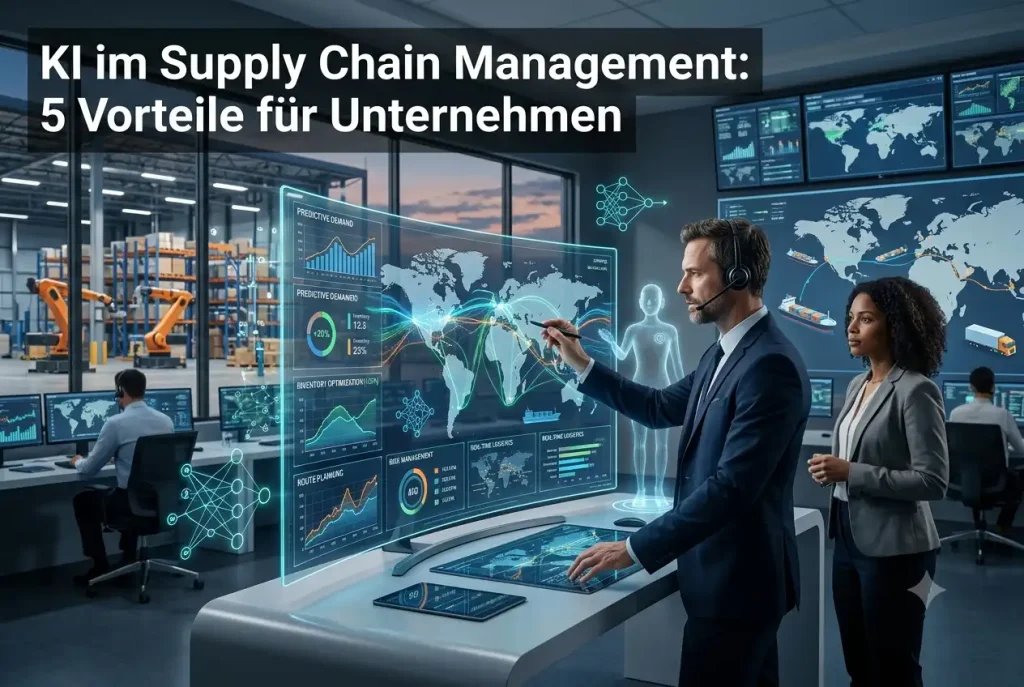
The bottom line upfront: By using AI in Supply Chain Management (SCM) Companies are transforming their supply chains from reactive cost-drivers into proactive, resilient value-creation networks. The greatest potential for improvement lies in the hybrid model: The symbiosis of algorithmic precision and human expertise reduces warehousing costs by up to 20 %, eliminates supply bottlenecks before they arise and optimises transport routes in real time. Those who fail to automate today will lose their competitive edge tomorrow.
Key facts about AI in Supply Chain Management at a glance
- Status Quo: Traditional, linear supply chains are no longer adequate for today's volatile markets.
- The Hybrid Model: Maximum efficiency is achieved when AI provides data-based suggestions, while humans make the final strategic decision.
- Top 5 Benefits: Precise demand forecasting, radically optimised inventory management, dynamic logistics, proactive risk management and automated procurement.
- ROI focus: AI-driven SCM demonstrably leads to higher delivery reliability, lower capital tie-up, and a reduced CO2 footprint.
Table of Contents
- 1. The Hybrid Model: Why the Symbiosis of Humans and AI is Winning
- 2. The 5 crucial advantages of AI in Supply Chain Management
- 3. Technical Integration: Data Infrastructure and Algorithms Behind the Smart Supply Chain
- 4. Success Story from Industry: Leap in Manufacturing Efficiency
- 5. Success factors in practice: Data quality and change management
- 6. Traditional SCM vs. AI-Powered SCM: A Direct Comparison
- 7. Conclusion: Your Roadmap for AI in Supply Chain Management
- 8. FAQ – Frequently Asked Questions about AI in Supply Chain Management
1. The Hybrid Model: Why the Symbiosis of Humans and AI is Winning
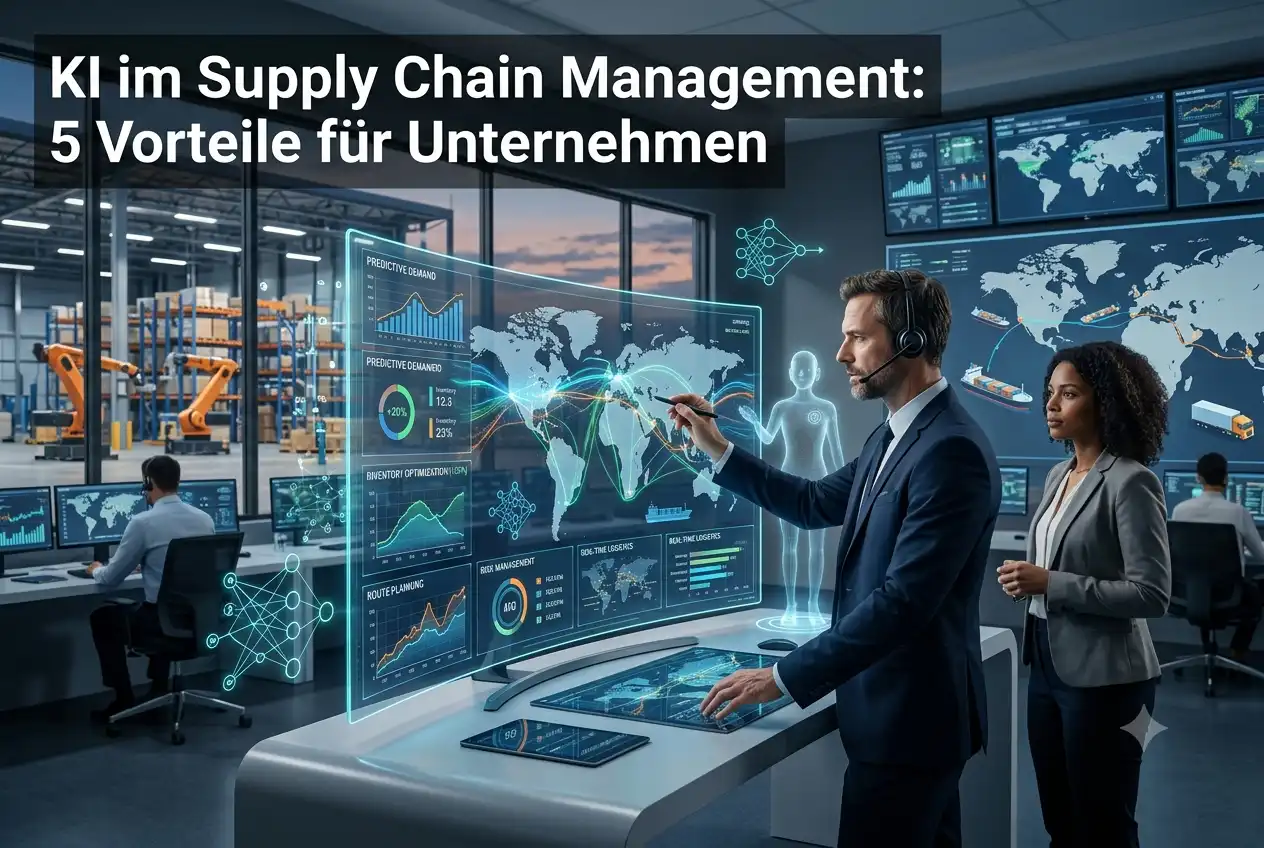
This collaboration prevents black-box decisions and ensures that algorithms are continuously readjusted by human experience.
2. The 5 crucial advantages of AI in Supply Chain Management
Benefit 1: Precise Demand Forecasting (Predictive Analytics)
Traditional forecasts are mostly based on historical sales figures from the past. AI systems, on the other hand, use machine learning to link internal data with hundreds of external variables:
- Current market trends and social media hype cycles
- Weather forecasts and seasonal variations
- Macroeconomic indicators (e.g., inflation rates, commodity prices)
The result: Companies know exactly which product is in demand, when, and in what quantity. Overproduction and out-of-stock scenarios are a thing of the past.
Benefit 2: Optimised Inventory Management & Minimisation of the Bullwhip Effect
The dreaded bullwhip effect arises from information distortions along the supply chain. AI breaks down data silos. If sales at the point of sale (POS) change, AI autonomously adjusts inventory levels and orders throughout the entire chain. This ties up less working capital in storage while simultaneously ensuring maximum delivery capability.
Advantage 3: Dynamic Route Planning & Green Logistics
Logistics in 2026 means flexibility by the minute. AI-powered fleet management systems recalculate routes not only before departure, but also dynamically adapt them during transit.
- Real-time factors: Traffic jams, bad weather, strikes, or delays at customs borders are bypassed immediately.
- Sustainability: By avoiding empty runs and optimising load capacities, fuel consumption and CO2 emissions are significantly reduced.
Advantage 4: Proactive Risk Management & Resilience
Supply chains are vulnerable to geopolitical crises, natural disasters, or supplier insolvencies. AI acts as an early warning system here. By scanning global news, weather data, and financial reports, AI identifies potential risks before they affect one's own production. In the hybrid model, the system directly suggests alternative suppliers or diversion routes.
Benefit 5: Automated Procurement & Intelligent Matchmaking
The Strategic Procurement Strategic procurement benefits massively from AI agents. Routine tasks such as invoice checks, master data maintenance, and tenders run fully automatically. Furthermore, AI analyses supplier performance (KPIs like delivery reliability and quality) and supports buyers in negotiations through precise price and market analysis patterns.
Would you like a brief consultation on this?


3. Technical Integration: Data Infrastructure and Algorithms Behind the Smart Supply Chain
To translate theoretical advantages into measurable performance, it's necessary to look under the hood of the technology. AI does not operate in isolation but requires a modern data architecture as its foundation.
- The data layer (Data Lake & ERP): AI systems consolidate structured data from ERP (e.g. SAP, Oracle) and WMS (Warehouse Management) systems with unstructured data (supplier emails, PDF certificates). Clean, real-time data cleansing via data pipelines is important here.
- Predictive algorithms (Machine Learning): Specialised neural networks such as LSTMs (Long Short-Term Memory) are used for demand forecasting. These are excellent at identifying temporal dependencies and seasonal patterns in sales data, which classical statistical methods often miss.
- Prescriptive Analytics (Reinforcement Learning): While predictive models forecast what will happen, prescriptive models determine what to do. In dynamic route or network optimisation, reinforcement learning algorithms simulate millions of scenarios to autonomously suggest the best option.
- Interfaces (APIs) & Edge Computing: To ensure that transport data from lorries or containers can be fed in without delay, modern SCM systems use IoT sensors on the freight. Data processing sometimes takes place directly at the sensor (edge computing) in order to raise an immediate alarm in the event of irregularities.
4. Success Story from Industry: Leap in Manufacturing Efficiency
A medium-sized automotive supplier faced a typical challenge: high safety stocks led to enormous capital tie-up, while unpredictable delivery delays for electronic components regularly brought production lines to a standstill. Procurement was largely reactive, managed via Excel.
In the course of digital transformation, the company introduced an AI-supported assistance system in a hybrid model:
- The measure: The system linked internal ERP inventory data with live tracking data from logistics service providers, as well as current global market reports on raw material shortages.
- The process in practice: When a severe storm blocked a central hub in Asia, the system proposed an automated recommendation for action to the purchasing team hours before the official logistics update: the temporary sourcing of components from a European secondary supplier.
- The result: thanks to proactive management, the impending production stoppage was completely averted. Within the first nine months of implementation, inventory costs fell by 18 % thanks to more accurate demand forecasts, whilst on-time delivery performance to car manufacturers rose to a record level of 99.4 %.
5. Success factors in practice: Data quality and change management
The technology behind modern SCM systems is highly advanced, yet their success in practice depends crucially on two fundamental pillars that are often underestimated.
Data Quality: The „Garbage In, Garbage Out“ Principle“
An algorithm can only calculate logical connections as well as the underlying database allows. In many companies, historical data stocks are fragmented or master data from ERP systems (such as supplier lead times, minimum order quantities, or packaging units) are outdated.
- The consequence: If the AI receives faulty input data, it generates incorrect forecasts and unsuitable order suggestions.
- The solution approach: The cleansing, structuring, and continuous maintenance of master data is the mandatory „Step Zero“ before any AI rollout. Only through automated data governance processes will the system be reliably maintained in the long term.
Change Management: Overcoming „Algorithm Aversion“
The best algorithm remains ineffective if the workforce distrusts it. Experienced dispatchers and planners in practice often tend to ignore AI-driven suggestions and instead trust their hard-earned gut feeling – a phenomenon known in the industry as algorithm aversion.
- The consequence: The system runs idle, manual corrections create new sources of error, and the hoped-for ROI fails to materialise.
- The approach to the solution: A successful hybrid model requires intensive change management. Planners must be involved in the implementation process from the outset. Trust is built through transparent „Explainable AI“ (XAI), which clarifies why an AI suggests a particular decision. The goal is to establish AI not as a threat, but as a digital sparring partner.
6. Traditional SCM vs. AI-Powered SCM: A Direct Comparison
- Database
- Traditional SCM: Historical Excel data, reactive working practices.
- AI-powered SCM (Hybrid Model): Real-time data from internal and external sources.
- Forecasting accuracy
- Traditional SCM: Often prone to errors during high market volatility.
- AI-powered SCM (Hybrid Model): Highly accurate through continuous machine learning.
- Reaction time
- Traditional SCM: Days to weeks due to manual analyses.
- AI-powered SCM (Hybrid Model): Seconds to minutes through automated real-time adjustment.
- Storage costs
- Traditional SCM: High, as large safety stocks are needed as buffers.
- AI-powered SCM (Hybrid Model): Low thanks to demand-oriented just-in-time optimisation.
- Manager's focus:
- Traditional SCM: Administrative routine tasks and time-consuming crisis firefighting.
- AI-powered SCM (Hybrid Model): Strategic Control, Innovation, and Relationship Management.
7. Conclusion: Your Roadmap for AI in Supply Chain Management
The implementation of AI in Supply Chain Management is no longer a question of „if“, but of „how quickly“. The key to success lies in the described hybrid model: do not overwhelm your organisation with full system autonomy, but establish AI as an intelligent assistant for your supply chain experts.
Consistently invest upfront in cleansing your data structures and involve your employees in the journey through targeted change management. This is the only way to secure the necessary agility to survive in the volatile markets of the future.
8. FAQ – Frequently Asked Questions about AI in Supply Chain Management
What data does AI need in supply chain management?
For starters, internal ERP and CRM data (historical sales, stock levels, supplier lead times) will suffice. As the system matures, more external data (weather, traffic data, market trends) will be integrated via APIs to maximise forecast quality.
Will AI replace the human supply chain manager?
No. The hybrid model shows that AI takes over monotonous data work from humans. The final strategic evaluation, ethical decisions and negotiations with partners remain a core competence of humans. AI is a tool, not a replacement.
What is the ROI for implementing AI in logistics?
In practice, corresponding software investments often pay for themselves within 12 to 18 months. The savings primarily result from the reduction of inventory holding and stockout costs, as well as more efficient transport routes.
How long does the implementation of corresponding systems in practice take?
A phased rollout is advisable. Initial pilot projects (e.g. for isolated demand forecasting) can often be realised within 3 to 6 months. The complete transformation towards an AI-driven end-to-end supply chain is a strategic process that can take 12 to 24 months.
What role does IT security play in the networking of systems?
As sensitive company data, supplier relationships, and pricing conditions are processed in real-time, IT security is of the utmost priority. Modern cloud solutions rely on end-to-end encryption, strict access controls (Zero Trust Architecture), and full GDPR compliance to minimise cyber risks.