




First and foremost:
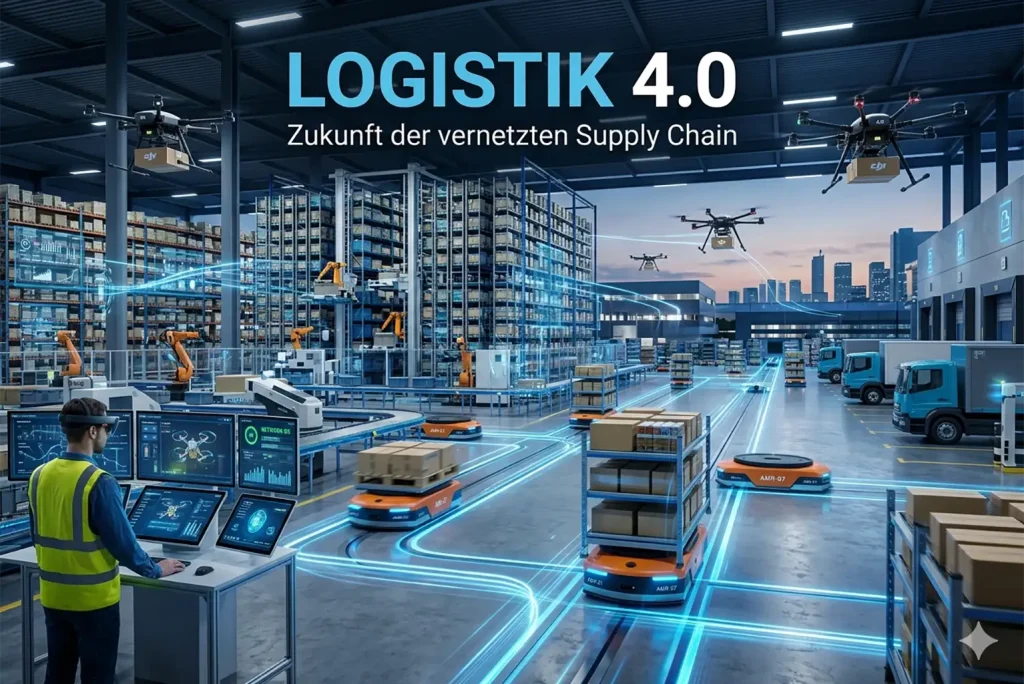
The Logistics 4.0 transforms the Supply Chain through Artificial Intelligence (AI) from a reactive chain to a preventative, autonomous ecosystem. While traditional systems are based on historical data, they enable AI Solutions like Predictive Analytics: how predictive analytics and digital twins enable decisions to be made in milliseconds. Companies that consistently implement these technologies report a reduction in process costs of up to 25% and a significant increase in resilience to global supply chain disruptions.
Key Facts on Logistics 4.0
- Definition: Integration of cyber-physical systems (CPS) and AI across the entire value chain.
- Technology Stack: Combination of IoT sensor technology, edge computing, and cloud-based machine learning models.
- Competitive Advantage: Transforming from „Just-in-Time“ to „Predict-in-Time“.
- KPI Impact: Reduction of empty runs by approximately 15 % and optimisation of working capital through 20 % lower safety stock levels.
1. Definition: What is Logistics 4.0?
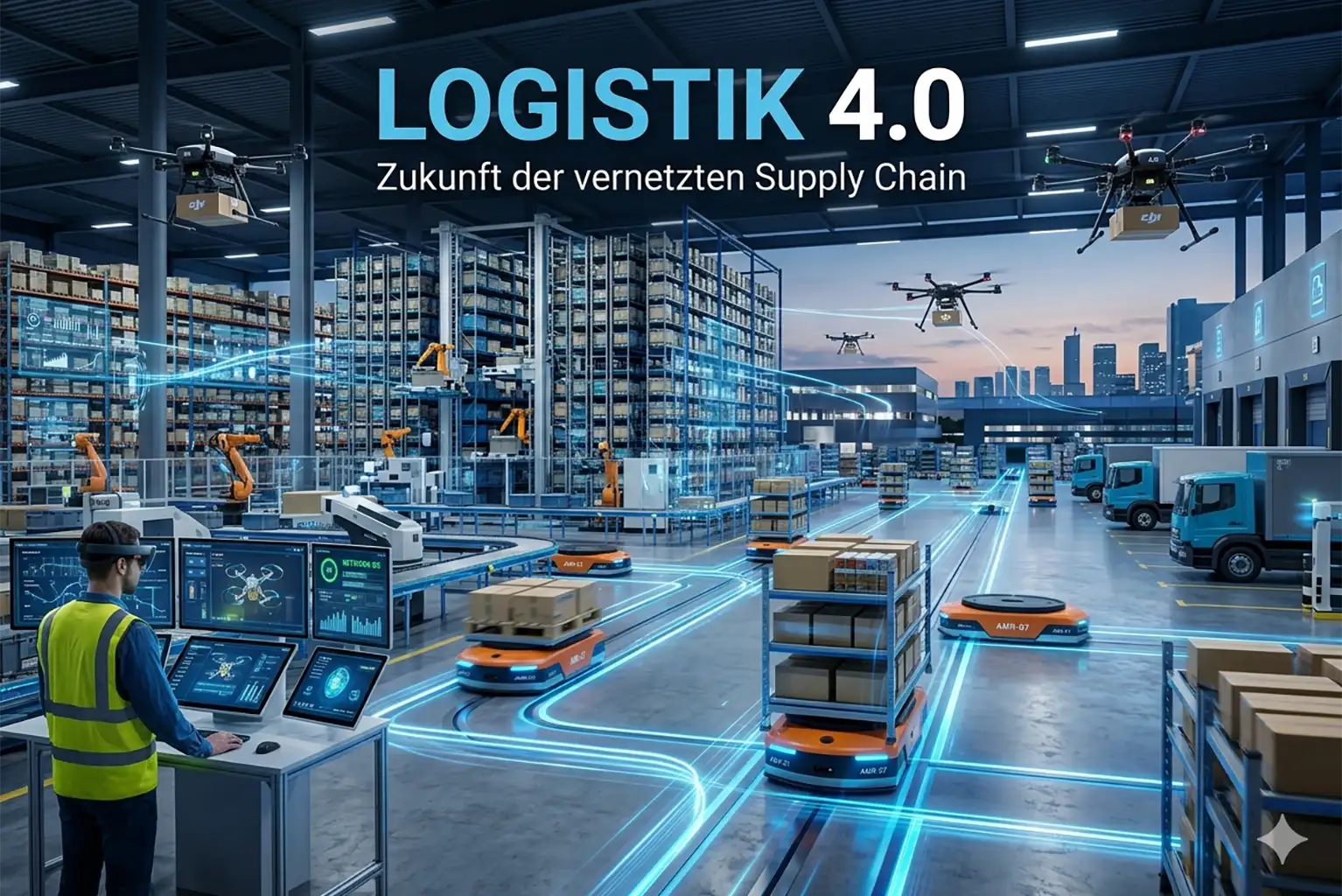
This concerns the deployment of cyber-physical systems (CPS). In this world, physical objects are linked to a digital identity. The goal is the „Smart Supply Chain“, which detects disruptions and optimises delivery routes in real-time without human intervention. A paradigm shift is taking place: away from centrally controlled systems towards decentralised, intelligent entities.
„The digitalisation of logistics is not a goal that is achieved once, but a continuous path of optimisation through data.“
2. The technological basis: AI as an orchestrator
Without AI, Logistics 4.0 would just be a huge mountain of untapped data. AI acts as the conductor, interpreting the data streams in real time:
- Machine Learning (ML): Identifies correlations between seemingly unrelated factors (e.g., overseas port congestion and local sales).
- Computer Vision & Sensor Fusion: Camera systems in goods receiving assess packaging integrity and recognise danger symbols without human intervention.
- Reinforcement Learning: Primarily used in intralogistics to teach autonomous robots how to move most efficiently in dynamic environments.
3. Strategic application areas for smart AI solutions
The theoretical framework of Logistics 4.0 only fully realises its value where enormous amounts of data meet complex operational decisions. AI doesn't just act as a tool here, but as a catalyst that resolves bottlenecks before they arise. By moving away from rigid planning cycles towards dynamic, demand-oriented control, companies can close the gap between efficiency and customer satisfaction. The following application areas demonstrate how smart algorithms are transforming the physical world of Logistics Redefine today.
A. Demand Sensing instead of Demand Forecasting
Classic forecasts look in the rearview mirror. Demand Sensing, on the other hand, uses real-time data from point-of-sale systems, weather reports, and social media trends to accurately predict demand for the next few hours or days.
B. Adaptive Intralogistics & VDA 5050
Through AI interfaces (like the VDA 5050 standard), traffic flows of transport robots from different manufacturers are centrally optimised to proactively avoid bottlenecks at packing stations.
C. Predictive Maintenance of the fleet
Sensors monitor the condition of lorries or sorting systems. The AI calculates the optimal maintenance time before a defect leads to a standstill – this saves repair costs and secures delivery capability.
Would you like a brief consultation on this?


4. Deep Dive: Digital Twins and the Simulation of Reality
The Digital Twin is the virtual replica of a physical logistics chain. It is continuously updated by real-time data from the IoT network.
- The „what-if“ advantage: What happens if a key route is blocked? A Digital Twin can play through thousands of scenarios in seconds and suggest the most efficient diversion.
- Real-time synchronisation: If reality deviates from the plan (e.g. a delay in the charging process), the model automatically adjusts the expected values for all downstream processes.
5. Practical Example: AI-Driven Scaling in E-commerce
A leading sporting goods manufacturer faced the challenge that manual inventory planning for 50 different markets led to enormous capital binding.
The solution: Implementation of an AI-driven „Inventory Optimizer“.
- Harmonisation: Bringing together data silos between ERP and CRM.
- Analyse: Inclusion of regional trends (e.g. local marathons) in inventory planning.
- Automation: Relocation between distribution centres before a local stock-out occurred.
The result:
- Capital release: €85 million through optimised inventories.
- Availability: Reduction of the out-of-stock rate from 12%to under 3%.
- Nachhaltigkeit: 15 % weniger Express-Nachlieferungen per Luftfracht.
6. Barriers and implementation strategies
The transition to Logistics 4.0 rarely fails due to technology, but rather due to structure:
- Legacy systems: Outdated software without API interfaces acts like a bottleneck.
- Change Management: Staff must be retrained from „manual workers“ to „system moderators“.
- Interoperability: Communication across company boundaries remains the biggest hurdle.
7. E-E-A-T Focus: Data Integrity as a Pillar of Trust
Within the Google Helpful Content System, expertise, experience, authoritativeness, and trustworthiness (E-E-A-T) are crucial. In Logistics 4.0, this means AI cannot be an uncontrolled black box. Real experience shows that algorithms are only as precise as the data that feeds them. „Garbage In, Garbage Out“ remains the golden rule. Without clean data integrity, even highly complex models will lead to costly misdecisions in route planning or inventory management.
Furthermore, trustworthiness plays a central role. This is where Explainable AI (XAI) comes into play. It is not enough for a system to suggest a rerouting; human experts need to be able to understand the logic behind it to ensure technological acceptance within the team and to meet legal compliance requirements in the global supply chain.
Expert tip: Do not trust AI whose decision-making process is a „black box“. Explainable AI (XAI) models are gaining importance in Logistics 4.0. They show the dispatcher not only that a route should be changed, but also why. This increases the system's acceptance.
8. Conclusion: The Strategic Roadmap for Autonomous Logistics 4.0
Logistics 4.0 is not a final state, but a continuous evolution. Companies must not misunderstand AI as a pure efficiency tool, but must grasp it as a core competence of their strategic alignment.
„In a connected world, transparency is no longer a luxury, but the fundamental prerequisite for any successful supply chain.“
The future belongs to the autonomous supply chain, which heals and optimises itself. Those who lay the foundation today with clean data structures (Clean Data) and scalable cloud solutions will be able to survive in a market that tolerates no delays. Investing in Logistics 4.0 is therefore not a cost decision, but insurance against the increasing volatility of global markets.
9. FAQ: Frequently Asked Questions about Logistics 4.0
What is the biggest advantage of Logistics 4.0 enabled by AI?
The shift from reacting to acting. Problems are solved or bypassed before they have any real impact on delivery reliability.
Can medium-sized companies also use Logistics 4.0?
Absolutely. Thanks to cloud-based software solutions (SaaS), even smaller businesses can use modular AI tools for route or inventory optimisation without having to make significant investments in their own IT infrastructure.
What role does the human play in the Logistics 4.0?
Man moves from being an „executor“ to a „strategist“. They take over the monitoring of AI systems and make decisions in complex strategic exceptional cases, while technology automates routine tasks.
How does Logistics 4.0 improve sustainability?
AI-powered route planning avoids empty runs and reduces mileage, massively lowering the supply chain's carbon footprint.