


Key Facts about LLMs in Procurement at a Glance
- Core technologies: Generative AI and Large Language Models (e.g. GPT-4, Claude 3.5, specialised open-source models) integrated into ERP and SRM systems.
- Key application areas: Automated contract management, spend analysis of unstructured data, AI-powered supplier correspondence, and automated risk management.
- The Hybrid Model: The optimal symbiosis of AI efficiency (scaling, speed) and human expertise (empathy, final approval, negotiation skills).
- Efficiency drivers: Up to 40 % time savings on administrative tasks and a significant reduction in maverick buying through smarter product category allocation.
- Challenges: Data protection (GDPR), AI hallucinations, and the need for „clean data“ as a foundation.
Table of Contents
- 1. What are LLMs and how are they changing shopping?
- 2. Key application areas in procurement
- 3. The Hybrid Model: Why „Human-in-the-Loop“ is Crucial
- 4. Technical deep dive: How RAG architectures eliminate hallucinations
- 5. Practical application: LLM deployment for a supplier price increase
- 6. Advantages and Challenges at a Glance
- 7. Step-by-step implementation guide
- 8. Conclusion: Procurement in the Age of Generative AI
- 9. FAQ: Frequently Asked Questions about LLMs in Procurement
1. What are LLMs and how are they changing shopping?
LLMs understand the context of language. They can interpret complex tender documents, spot deviations in global supply agreements, and pre-draft tailor-made emails for negotiations. Consequently, purchasing is transforming from a reactive, administrative function into a proactive, data-driven value driver within the company.
2. Key application areas in procurement
Intelligent contract management
Manually checking hundreds of supplier contracts for compliance risks or liability clauses takes weeks. LLMs analyse contracts in seconds:
- Clause comparison: Immediate detection of deviations from company-specific standard terms and conditions.
- Fresh deposits: automatic reading and transfer of notice periods and price adjustment clauses into the ERP system.
Spend Analysis and Master Data Cleansing
Accurate purchasing analyses often fail due to poor data quality (e.g., inconsistent supplier names or incorrectly categorised invoices). LLMs use semantic understanding to correctly map free-text fields. From „Screw ISO 4017“ and „Hex bolt M8“, the AI automatically recognises the same product group and consolidates the spend.
Automated supplier communication and negotiations
With hundreds of suppliers, individual relationship management in operational purchasing is hardly possible. LLMs can support this as co-pilots:
- Offer comparisons: AI reads incoming offers (including unstructured PDFs), displays them in a comparison matrix and drafts rejection or re-negotiation emails directly.
- Argumentation aids: Before negotiations, the LLM analyses the supplier's historical performance and provides the buyer with the strongest arguments (e.g. drops in delivery reliability in the last quarter) free of charge.
ESG & LkSG Compliance (German Supply Chain Due Diligence Act)
Regulatory compliance is increasingly demanding of procurement. LLMs can efficiently handle the enormous mountains of documents:
- Risk Scanning: The system scans hundreds of sustainability reports, codes of conduct, and supplier self-assessments in seconds for incomplete details or discrepancies.
- Early warning system: AI-powered analysis of global news and media reports in real-time can identify geopolitical risks or strikes before supply bottlenecks arise.
3. The Hybrid Model: Why „Human-in-the-Loop“ is Crucial
A pure AI procurement is risky and often not legally permissible. The hybrid model relies on the combination of human empathy and strategic foresight paired with the scalability and speed of AI.
The process follows a clear, three-stage principle:
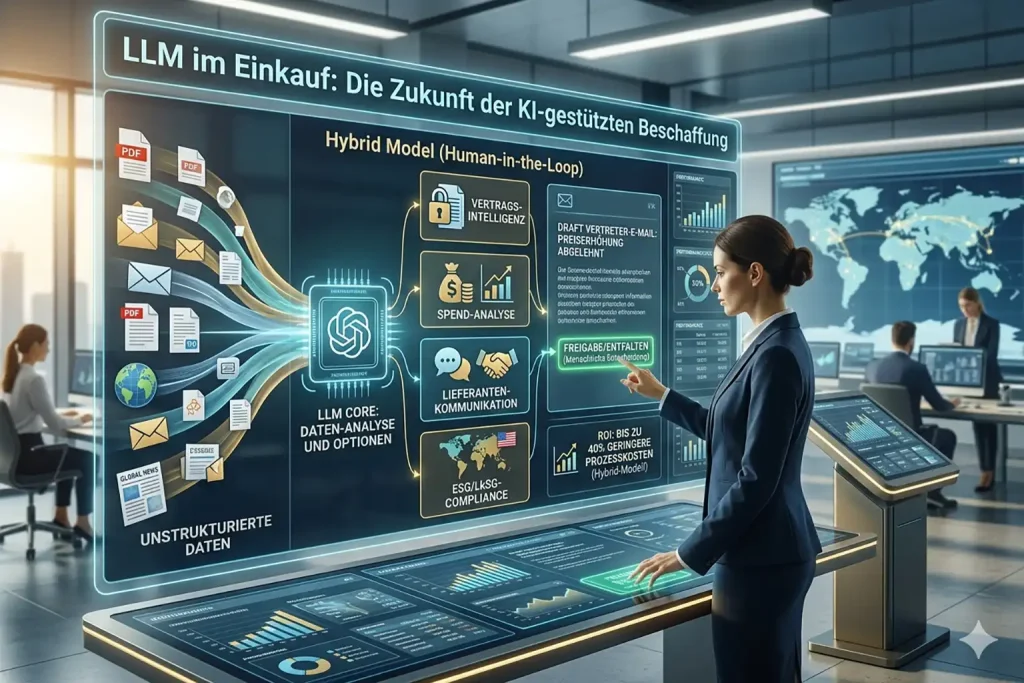
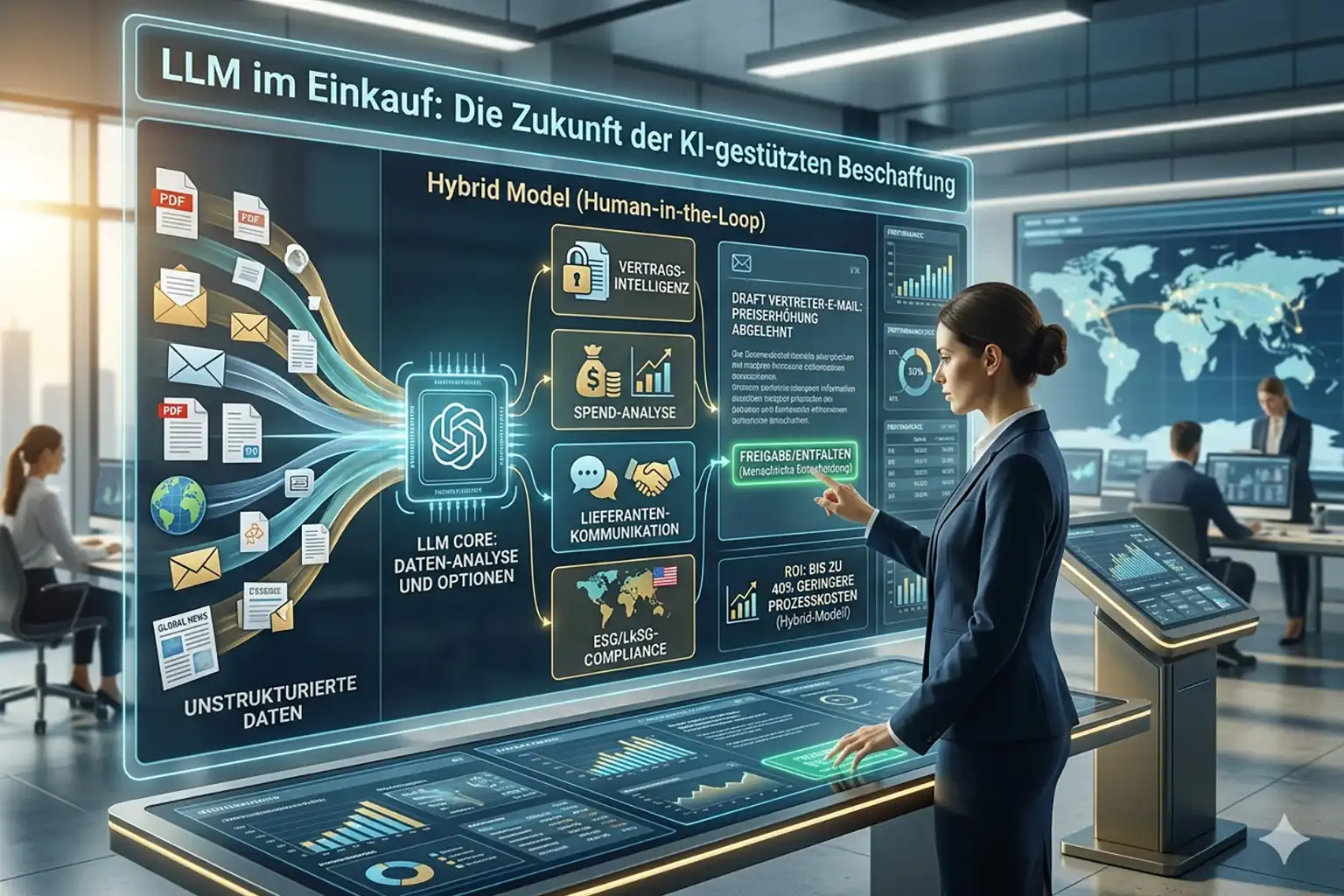
- Data input: Unstructured data such as contracts, offers, or emails are received in the system.
- AI processing: The LLM takes on the time-consuming task of analysing, filtering, and drafting documents or responses.
- Human-in-the-loop: The strategic buyer reviews the outcome, conducts the final negotiation, and approves the process or deal.
AI acts as a highly efficient support service provider. It processes data, creates drafts and suggests options. The final decision, the final approval of orders and the development of personal relationships with key suppliers remain 100 % with the strategic buyer. This ensures compliance with guidelines and prevents costly errors caused by AI hallucinations.
Would you like a brief consultation on this?

4. Technical deep dive: How RAG architectures eliminate hallucinations
One of the biggest risks when using standard LLMs in mission-critical procurement is so-called „hallucination“ – the invention of seemingly plausible but factually incorrect information. This is unacceptable for the reconciliation of supplier data or contract clauses. The technical solution for B2B companies is called RAG (Retrieval-Augmented Generation).
Instead of retraining the language model with internal data through extremely expensive and complex „fine-tuning“, a RAG architecture places an internal vector database in front of the LLM.
The process works as follows:
- The query: A buyer asks the system: „Which framework agreements contain a price escalation clause for steel?“
- Retrieval: The system does not search the entire internet, but exclusively searches the proprietary, company-owned database (e.g. ERP, SRM or SharePoint) for relevant text passages.
- The augmentation: The identified, genuine contract texts are transmitted to the LLM together with the question.
- Generation: The LLM now formulates a precise answer – but exclusively draws on the facts provided to it.
This technical approach downgrades the LLM from a „knowledge source“ to a pure „text processor“. The error rate drops to near zero, as the AI must provide an exact source from its own company data for every statement. Furthermore, all data streams remain protected within the company's secure cloud infrastructure.
5. Practical application: LLM deployment for a supplier price increase
To make the functionality of the hybrid model tangible, this scenario shows the process for an unannounced price increase by a strategic supplier of packaging materials:
- Step 1: Automated receipt The supplier sends an email with a PDF attachment announcing a price increase of 8 % due to rising energy costs. The integrated LLM immediately captures the unstructured email and the document, extracts the key requirements and reconciles them with the ERP system in the background.
- Step 2: AI-assisted data preparation The system uses the RAG architecture to identify the existing framework agreement. The AI determines that, according to the contract, a price increase is only permitted from the next quarter onwards and by a maximum of 3 %. At the same time, the LLM analyses commodity indices on the web and recognises that energy prices have fallen in real terms over the relevant period.
- Step 3: The draft strategy The AI automatically generates an overview for the buyer. It immediately drafts a reply to the supplier: polite in tone, but uncompromising on the substance. The draft refers specifically to Clause 4 of the framework agreement and to the latest market data, and provides a well-founded rejection of the 8 % terms.
- Step 4: Human Decision (Human-in-the-Loop) The strategic buyer opens their dashboard and sees the completed dossier along with the draft email. They do not have to painstakingly gather the data. They review the text, adjust a nuance for a personal touch, and send the email. Negotiation power remains with the human – prepared in seconds by the AI.
6. Advantages and Challenges at a Glance
For a quick and focused comparison, the key opportunities and risks of the technology are summarised here:
- Advantage: Huge time savings Routine tasks such as sourcing requests and complex text analyses are automated.
- Challenge: Hallucinations. The AI may invent facts or data points under certain circumstances.
- Proposed solution: Strict four-eyes principle. No automated action is carried out without human approval for critical processes.
- Advantage: Higher transparency, better detection of patterns in global spend, and early identification of supply chain risks.
- Challenge: Data protection and IP protection. Sensitive purchasing data must not leak into public LLMs.
- Solution approach: Use of closed enterprise solutions (e.g. in private clouds) with a RAG architecture.
- Advantage: Better conditions. The AI finds alternative sourcing options faster, compares offers more precisely, and provides hard benchmarks.
- Challenge: Acceptance within the team. Buyers fear job losses.
- Solution approach: Active change management. The AI will be positioned as a relief from tedious administrative work („The digital co-pilot“).
7. Step-by-step implementation guide
- Use Case Definition: Don't start with an all-encompassing project. Choose a clear, low-risk use case (e.g., summarising supplier audit reports or pre-drafting standard RFQs).
- Architectural Choice (RAG): Utilise the principle of Retrieval-Augmented Generation (RAG). In this approach, the LLM accesses a closed, internal company knowledge base (e.g., your existing contracts in SharePoint) rather than general internet knowledge. This minimises hallucinations to virtually zero.
- Defining human guardrails: Set thresholds. Up to what purchase volume is the AI allowed to prepare suggestions autonomously? Who signs off in the end?
- Prompt Engineering & Training: Train your purchasing team in the correct use of AI. The more precise the prompts (input commands), the higher the quality of the AI's results.
8. Conclusion: Procurement in the Age of Generative AI
LLMs in Procurement are not a temporary trend, but the new standard for modern procurement organisations. Those who successfully establish the hybrid model free up their buyers from data-intensive routine work and transform the department into a strategic powerhouse. The crucial success factor from now on is the pure speed of adaptation: Companies that set organisational course today and bring pragmatic pilot projects to life secure tomorrow's digital market leadership. Technology does not replace the buyer – but the buyer who uses AI will replace the buyer who ignores it.
9. FAQ: Frequently Asked Questions about LLMs in Procurement
Can an LLM conduct price negotiations independently?
No, at least not in the strategic domain. An LLM can devise negotiation strategies, aggregate historical data, and draft emails. The final negotiation – especially when it concerns nuances, long-term partnerships, or complex supply chains – requires human intuition.
How secure is our confidential purchasing data when using AI?
When using free consumer tools (like the standard version of ChatGPT), data often feeds into general training – this is taboo for procurement. Companies must rely on enterprise licences (e.g. Microsoft Azure OpenAI) or local open-source models, where it is contractually guaranteed that data will not leave the protected company environment.
What is the difference between traditional retail AI and LLMs?
Traditional AI in procurement is mostly based on numerical machine learning logic (e.g., anomaly detection in invoices or predictive pricing). It requires highly structured tables. LLMs, on the other hand, are language-based. They excel where texts, contracts, emails, and unstructured information need to be processed. Both technologies complement each other ideally.
Welche Voraussetzungen müssen für die Einführung von LLM im Einkauf erfüllt sein?
For successful implementation, three factors are crucial: Firstly, a solid data foundation (clean data), as poor master data distorts AI results. Secondly, the definition of clear, low-risk use cases for the start. Thirdly, targeted training of the purchasing team in so-called prompt engineering, in order to extract precise and reliable results from the models.