Key facts about AI in mechanical engineering
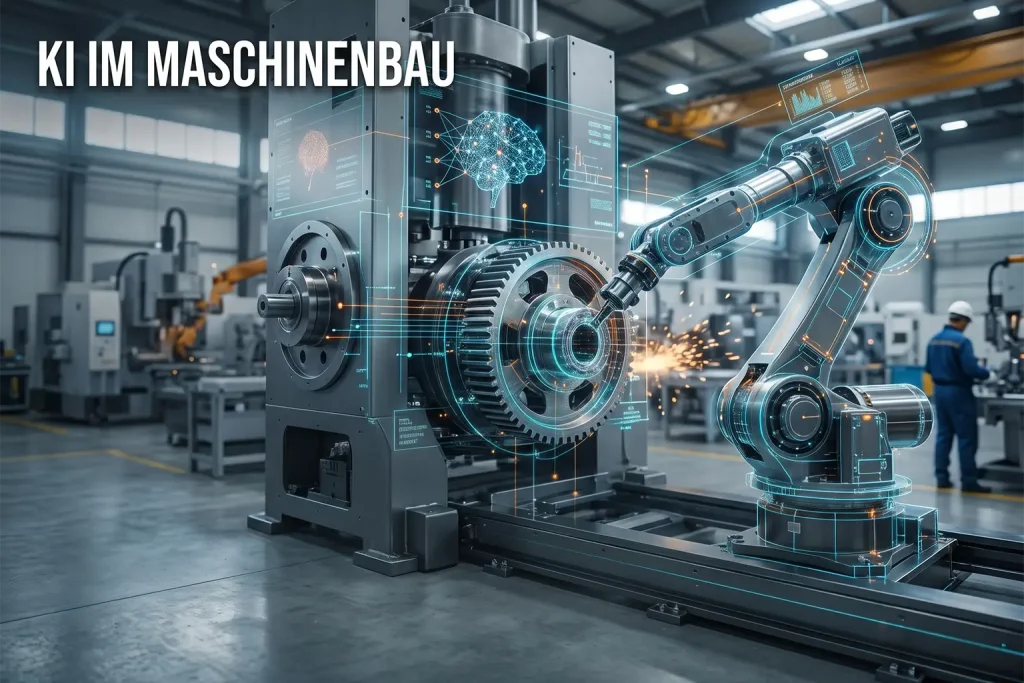
- Technological focus: Machine learning, computer vision and industrial speech models directly evaluate sensor streams, vibration patterns and process data at the machine or in the control room.
- The hybrid principle: Neural networks are limited by physical conservation laws. This prevents mathematical misinterpretations and reduces the need for training data by up to 80 percent.
- Typical application areas: Predictive maintenance of core components, automated optical quality inspection in line with the production process, and dynamic feed control for stamping processes.
- Business management benefits: An increase in overall plant efficiency (OEE) of 5 to 15 percentage points, lower material and energy consumption, and the permanent safeguarding of know-how despite a shortage of skilled workers.
- Critical success factors: a clean separation between functional security technology (security SPS) and AI control, the control of ongoing operating costs (TCO), and compliance with the EU AI Act.
1. What is AI in mechanical engineering? Definition and basics
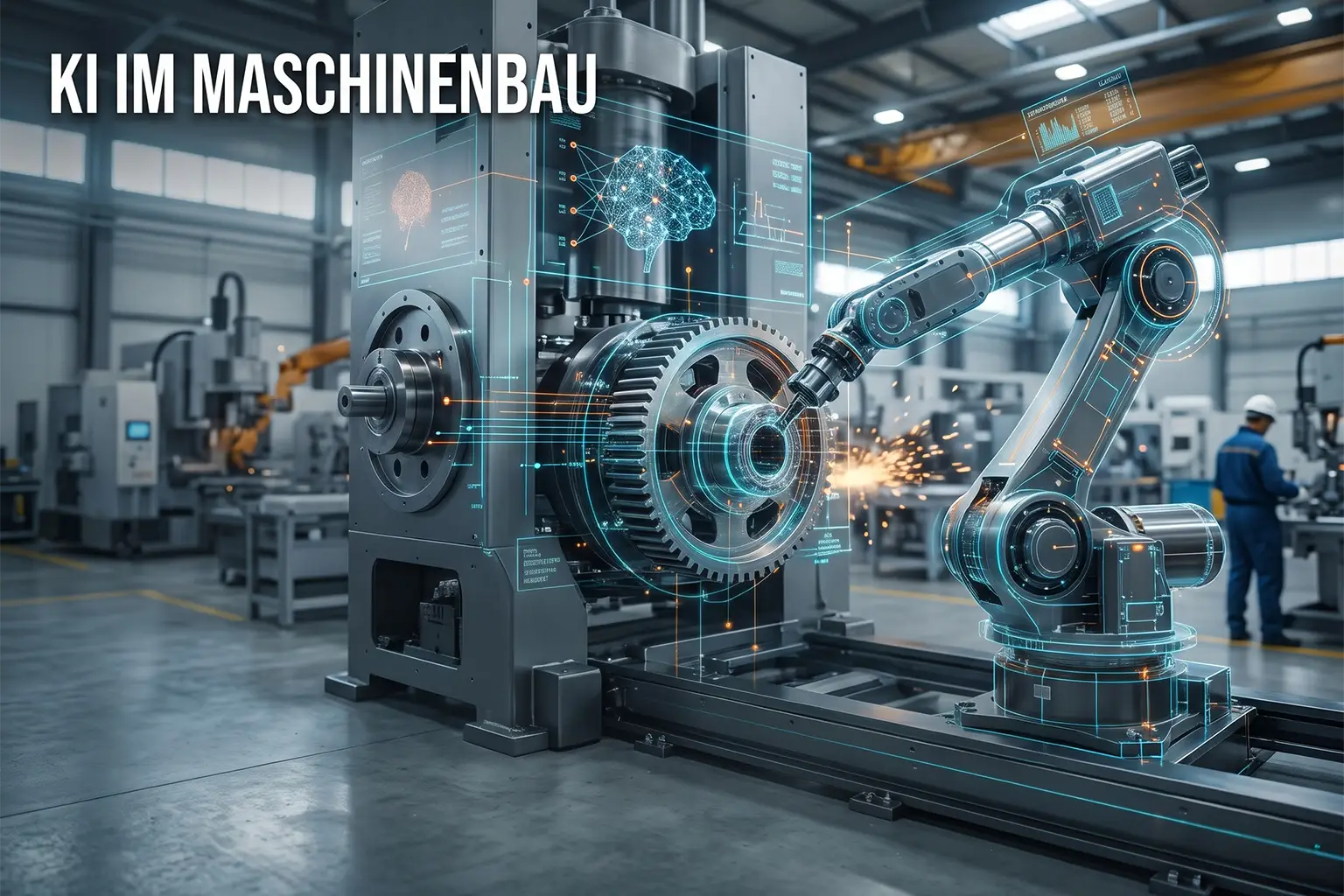
In practice, three stages of development can be distinguished from each other:
- Classical automation: Machine controls operate according to fixed programmed if-then specifications and mathematical control circuits. If the operating conditions change – for example, because the raw material fluctuates or the cutting tool wears out – the rigid control system cannot react and the plant shuts down.
- Pure data-driven AI: Algorithms search through historical data for statistical correlations. For mechanical engineering, this purely black-box approach often falls short: Serious machine failures are fortunately rare, which is why there is little training data available. Moreover, pure data models tend to create associations that contradict the laws of physics or mechanics.
- The hybrid model (physically informed AI): This approach is being adopted in industrial practice. Mathematical natural laws—such as impulse rates, thermal conduction, or material elasticity—are provided to the algorithm as fixed guiding principles. The model learns exclusively within this physically feasible framework. This saves enormous amounts of data during training, eliminates absurd computational errors, and provides comprehensible results for everyday production operations.
2. The hybrid model in detail: Physics-Informed Neural Networks (PINNs)
In the factory, standard AI methods almost always fail with the same problem: the lack of real error data. No production manager would intentionally crash a $500,000 spindle just to record training curves for an algorithm. Physics-informed neural networks (PINNs) solve this dilemma by marrying data analysis with formula knowledge from solid-state and fluid dynamics.
»An algorithm without a physical foundation remains an unpredictable risk in manufacturing. Only when sensor data matches physical laws does industrial reliability emerge from pure correlation.«
How the two-stage error control works
During training, a normal neural network only checks whether its prediction matches the stored measurement values. The hybrid model instead uses two separate control mechanisms simultaneously:
- Comparison with real measurement values: The network compares its prediction with the real measured values at the machine (for example, pressure curves, vibrations, or surface temperatures).
- Physical plausibility check: In parallel, a mathematical calculation module checks whether the result meets known physical equations – for example, the Navier-Stokes equations for lubricants or the Fourier law for heat transfer.
- Automatic countermeasure: If the AI calculates a behavior that could generate energy from nothing, the physical formula generates a mathematical error value. The algorithm must immediately correct its parameters until the output matches both the sensor data and the laws of nature.
Reliability even under extreme conditions
Classical data models can only assess what they have already seen before. If a milling machine suddenly runs at full load or at 35 degrees Celsius in the high summer, purely statistical networks tend to be wrong.
Because physical laws apply everywhere, the hybrid model also provides stable predictions in such boundary regions. Even operating conditions that have never been tested on the actual machine can be calculated with precision.
The tangible benefits on the workbench
- Few data are needed: Instead of collecting millions of sensor points for years, often only a few measurement series at the machine are sufficient. Physics severely restricts the solution space from the very beginning.
- Real-time calculation: computationally intensive simulations (such as FEM or flow analyses), which previously took half a day on workstations, run as a trained surrogate model in milliseconds directly on the machine control system.
- Virtual sensors: The AI calculates process values at components where a physical sensor cannot be installed due to space or heat constraints – for example, the mechanical tension deep inside a gearbox or the temperature at an inaccessible weld seam.
3. How is artificial intelligence used in mechanical engineering?
From the initial component sketch to worldwide customer service, intelligent software now intervenes in virtually all stages of the machine lifecycle.
Design and construction
Engineers use generative design software. The designer defines load limits, mounting points, and the manufacturing process; the algorithm then calculates organically shaped lightweight geometries that save material and are optimized specifically for 3D printing or 5-axis milling. In addition, AI-based replacement models drastically shorten calculation times for strength and vibration simulations.
Manufacturing and machining
When turning, milling, or grinding, algorithms capture the motor currents of the axes as well as the body noise at the spindle. If the software detects atypical load peaks or chatter vibrations, the control system adjusts the cutting depth and feed rate in the current engagement. This saves the tools and reduces cycle times. In assembly cells, robots with 3D camera systems take on the safe separation of disordered bulk material parts.
Inline quality assurance
Camera systems with deep learning algorithms inspect surfaces, welds, and stamped parts directly during the production process for microcracks, dents, or dimensional accuracy. Additionally, acoustic testing benches listen to the sound pattern of assembled transmissions or motors and sort units with bearing damage or tooth defects before shipping them.
Maintenance and After-Sales
In predictive maintenance, software monitors the vibration behavior of bearings, guides, and hydraulic valves. Instead of replacing expensive assemblies based on operating hours or suspicion alone, the machine reports its maintenance needs based on the condition. Service technicians use specialized industrial speech models on-site to scan the wiring diagrams and service reports and provide precise repair instructions.
Would you like a brief consultation on this?


4. Concrete use cases: AI in industrial applications
Four typical application areas demonstrate how the technology can be used in everyday production:
- Machining tools: By continuously monitoring spindle currents and high-frequency body noise, anomaly models detect beginning cutting edge fractures in fractions of a second. Tool fractures can thus be reduced by around 85 percent; at the same time, the cutting speed increases by well over 10 percent.
- Plastic injection molding: Physics-informed models capture tool internal pressures, cylinder temperatures, and melt flow data. If the material quality – for example, when recycling granulate is added – fluctuates, the system automatically adjusts the injection curve. This reduces the rejection rate by around 20 percent.
- Welding robots: Image processing models evaluate arc parameters and thermal imaging cameras simultaneously. Pores and bond defects are detected directly during the welding process. Time-consuming, destructive grinding image tests in the laboratory can be largely eliminated.
- Compressed air and vacuum systems: Classification models analyze flow data and ultrasonic curves to locate leaks in pipeline networks. In large manufacturing halls, this often reduces energy costs for compressors by 15 to 20 percent.
Detailed scenario: Predictive maintenance of a winding machine
In a metalworking plant, bearing damage to the guide rollers of a tape winding system repeatedly led to blockages and tape breaks. Each stoppage cost several hours of setup time and several tons of waste material.
The plant has equipped the 24 main storage locations with compact acceleration sensors. A small industrial PC at the facility continuously processes the vibration signals. Instead of rigid limits, the model detects subtle frequency shifts that are typical for incipient damage to the bearing tracks. The system warns the maintenance team 150 to 200 operating hours in advance of the actual bearing failure. The replacement is scheduled for downtime that is already imminent; unplanned downtime is a thing of the past on this line.
5. What benefits does AI offer for machine engineering companies?
For machine builders and plant operators, the use of software pays off at four key operational points:
- Increase in overall plant efficiency (OEE): Machine availability, production speed, and part quality all increase simultaneously. Unplanned downtime is avoided, minor disruptions in the material flow are automatically corrected, and measurement deviations are eliminated before any waste is created.
- Reduced energy and resource consumption: Production plants consume a lot of electricity, lubricants, and compressed air. Intelligent controls automatically throttle auxiliary units during breaks, optimize heating and cooling circuits based on demand, and minimize material waste during the start-up of processes.
- Maintaining operational expertise: As experienced masters and machinists retire, their sense for machine operations is at risk of being lost. Algorithms preserve this knowledge: They record acoustic profiles and optimal set-up data and support trained operators with clear suggestions.
- Basis for operator models (Equipment-as-a-Service): Increasingly more customers no longer want to buy machines; instead, they pay per finished item or guaranteed availability hour. Such a business model only works for the manufacturer if he can precisely control the risk of downtime for his fleet of machines from a distance.
6. Strategies for the implementation of AI in mechanical engineering
Most digitalization projects fail not because of the software, but because of unclear goals and inaccessible data. A gradual approach prevents costly misinvestments:
»The economic success of AI in mechanical engineering is not determined by theoretical computing power, but directly by the floor of the hall: A practically solved everyday problem weighs more for production than any even the most complex pilot project.«
- Addressing the biggest bottleneck: Don’t ask what is technically feasible, but where delays and outages cost the most money. A clearly defined goal – such as „reduce line 2 delays by 15 percent“ – forms the right foundation.
- Connecting OT and IT: The signals from the factory floor (SPS, CNC control, sensors) must flow cleanly into overarching systems (MES, ERP). Open interfaces such as OPC UA and standard protocols like MQTT ensure that machine data can be used independently of the manufacturer.
- Retrofit existing machines: A retrofit almost never requires a new system. External clamp sensors for current, vibration and pressure can be quickly installed without interfering with the existing machine’s safety-relevant PLC certification.
- Distribute computing power wisely: Anything that needs to respond within milliseconds or contains sensitive process know-how is processed directly on the machine on edge devices. The cloud primarily serves to compare fleet data across factories and to further develop computing models.
- Plan ongoing model maintenance: Mechanical wear, changed delivery batches for steel, or summer hall temperatures change the measurement values over time. Without regular monitoring and night training of the models, the predictive accuracy declines after a few months.
Make-or-Buy Decision and Total Cost of Ownership (TCO)
Sooner or later, management faces the fundamental question: develop in-house or purchase pre-built software components? Both approaches require an honest assessment of the total costs over the entire life of the system.
- In-house development (Make): Building your own software and data science teams ensures full data ownership and your own patent and protection potential. This is especially worthwhile if the algorithm constitutes the machine’s actual competitive advantage. On the flip side, it comes with high personnel costs for specialists and long development times until it is ready for mass production.
- Acquisition and collaboration (Buy): Pre-configured industrial platforms, no-code analysis tools, and retrofit sensor kits save time and often yield initial results after just a few weeks. However, this entails ongoing license costs and a significant dependence on the respective software provider.
Anyone calculating the total cost of ownership (TCO) must not only look at the purchase price:
- Ongoing model maintenance (MLOps): Algorithms age due to process shifts. Monitoring and occasional night training cause continuous workload.
- Sensor maintenance and calibration: Harsh workshop conditions require precision instruments. Regular inspections and replacement parts must be firmly included in the maintenance budget.
- Cybersecurity and software updates: Connected computers on the machine are attack points. They must be regularly provided with security patches over a period of ten or fifteen years, even to meet legal requirements such as the Cyber Resilience Act.
- Team training: Software is useless if workers and maintenance personnel distrust it. Regular training on the floor is mandatory to ensure that the system is accepted in everyday life.
7. Challenges, regulation and risks
The transition to the intelligent machine brings with it tangible technical and legal challenges:
- The problem with good condition: Because machines operate stably in normal operation, 99 percent of all measurement data consists of inconspicuous operating states. Traditional training based on known errors fails here. The solution lies in models for pure anomaly detection that learn the normal state and report any even the slightest deviation.
- Safety always comes first: A neural network works with statistical probabilities – functional safety, however, requires guaranteed shutdown in case of emergency. Therefore, software must never over-control safety door switches or emergency exit circuits. Security-oriented controls and optimizing algorithms must remain strictly separated on a hardware and software level.
- EU AI Act and liability issues: When AI is used for safety-relevant functions, European authorities classify the overall system as high-risk AI. This means: complete logging of training data, documented risk management, effective protection against manipulation, and proof that the human always retains control over the machine.
8. AI Trends in Machine Building in 2026 and beyond
Mechanics and software are becoming increasingly closely intertwined in industrial manufacturing. Four trends will dominate the coming years:
- Industrial basic models: Instead of having to learn a completely new model from scratch for each machine, preconfigured basic models are used. These already provide a broad understanding of mechanical relationships and can be adapted to a new machine with just a few example data.
- Workshop assistants with a camera and language skills: If a fault occurs, the operator films the machine with a smartphone. The software compares the image with design data and wiring diagrams and explains step by step how to fix the problem.
- Intelligence directly in the sensor housing: New, extremely energy-efficient semiconductors enable data analysis to be performed directly in the housing of the measuring sensor. The sensor no longer transmits cluttered raw data; instead, it directly reports the component status to the control system with minimal power consumption.
- Self-correcting manufacturing systems: Machines adapt their tool paths independently during thermal deformation, promptly request wear parts from the warehouse, and balance cutting speeds so that power consumption and tool downtime are in optimal proportion.
9. Conclusion: AI in mechanical engineering
AI is in mechanical engineering No longer just a theoretical future topic, but a key lever for the competitiveness of manufacturing companies. Its greatest strength lies in the combination of engineering expertise and algorithms: the hybrid model combines established laws of mechanics and thermodynamics with the pattern recognition of modern networks.
Companies that open their machine data through open interfaces, pragmatically retrofit their existing systems, and use AI to address specific operational bottlenecks ensure the availability of their production and create the foundation for future-proof, software-driven services.
10. Frequently Asked Questions (FAQ) about AI in mechanical engineering
Is AI also suitable for small and medium-sized machine builders?
Yes, medium-sized companies rarely have to program algorithms themselves. Preconfigured edge sensors, standardized retrofit packages for existing machines, and specialized no-code software enable a quick, cost-effective entry with directly measurable economic benefits.
What is the difference between classical automation and AI?
Classical automation operates according to rigid, pre-defined rules. If unexpected process fluctuations occur, the system stops operating. Artificial intelligence, on the other hand, recognizes changing patterns in sensor data, dynamically adjusts process parameters to accommodate evolving changes, and thus supports uninterrupted operation.
How does the hybrid model solve the problem of missing error data?
Damage events are rare in mechanical engineering, which is why real training data for defects is lacking. With the hybrid model, physical simulation calculations feed realistic error scenarios into the model. The AI thus learns from physically correct data without the need to cause real machine damage.
What requirements does the EU AI Act impose on machine manufacturers?
If AI is used in safety-related functions, the requirements for high-risk systems apply. Manufacturers must demonstrate a functioning risk management system, document the quality of data sets, ensure protection against cyberattacks, and ensure that humans retain final control at all times.
Why do some AI projects in industry get stuck?
Common reasons include insufficient networking between machine control and corporate IT, unstructured data formats, and a lack of economic objectives. Furthermore, projects fail when the operator staff is not involved early enough and the necessary trust in the automated suggestions is lacking.