


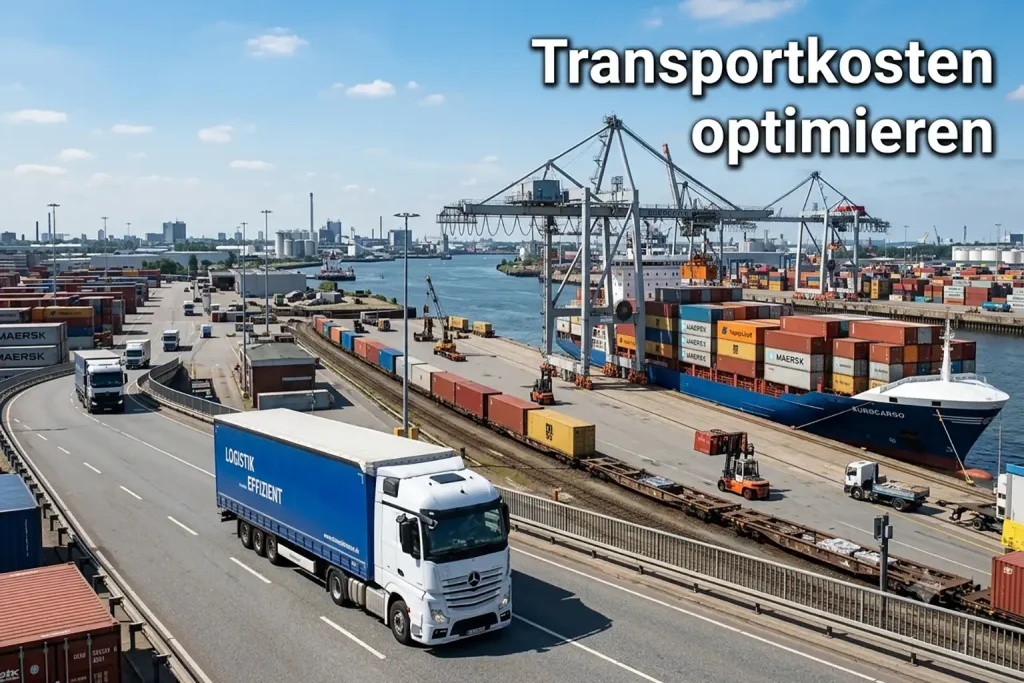
Given rising toll rates, CO2 charges, and a persistent driver shortage, it is possible to Shipping costs can no longer be achieved purely by putting pressure on service providers to lower their prices. The key to a sustainable cost reduction of 15 % to 25 % lies in a hybrid approach: the intelligent consolidation of loads (LTL to FTL), digital route optimisation using modern TMS, and strategic, partnership-based cooperation with logistics service providers.
Key Facts to Optimise Transport Costs
- Block primary additional costs: Dead mileage and insufficient capacity utilisation cause the most unnecessary logistics costs.
- Most effective lever: The Amazonisation of B2B logistics through the consolidation of less than truckload (LTL) into full truckload (FTL).
- Technology ROI: Transport Management Systems (TMS) often pay for themselves in the first year through dynamic route planning.
- E-E-A-T Practical Tip: Opt for transparent „gain-sharing“ models with hauliers, instead of just seeking the cheapest spot market price in every tender.
Table of Contents
- 1. The current price drivers in logistics
- 2. Strategy 1: Load Bundling and Network Optimisation
- 3. Strategy 2: Digitalisation & Dynamic Tour Planning
- 4. Strategy 3: Strategic Procurement and Freight Tenders
- 5. Deep Dive: Predictive Logistics & AI-powered Freight Invoice Verification
- 6. Case study: 18 % savings in a medium-sized mechanical engineering company
- 7. Strategy 4: Green Logistics as a Money-Spinner
- 8. Conclusion: Optimising transport costs effectively for the future
- 9. FAQ: Optimising Transport Costs – Questions & Answers
1. The current price drivers in logistics
To counteract this, it is not enough to simply want to negotiate freight rates down. Those who put too much pressure on their partners will simply be left stranded during capacity shortages. What is in demand is expert knowledge combined with data-driven processes – the so-called hybrid model of human logistics expertise and algorithms.
2. Strategy 1: Load Bundling and Network Optimisation
The most expensive lorry is one that travels half empty. The consolidation of goods flows is therefore the lever with the greatest leverage.
„Efficiency in logistics doesn't mean driving faster, but connecting routes more cleverly.“
- FTL instead of LTL: Try to schedule shipments so that a full truckload (FTL) is created instead of several less-than-truckload (LTL) shipments.
- Establish milk-run concepts: Utilise round trips where a lorry strategically visits various suppliers one after another, collecting the goods and delivering them to the central warehouse.
- Cooperating with Partners: Are there perhaps companies in your neighbourhood with similar delivery areas? Collaborative logistics can drastically reduce costs for both sides.
Overview of optimisation approaches and savings potential
- Less than truckload to full truckload consolidation
- Potential savings: 15 % – 20 %
- Complexity: Medium (requires flexible delivery windows)
- Milk Run Introduction
- Potential savings: 10 % – 15 %
- Complexity: High (strong supplier coordination required)
- Packaging optimisation (more goods per pallet)
- Potential savings: 5 % – 12 %
- Complexity: Low to Medium
3. Strategy 2: Digitalisation & Dynamic Tour Planning
Manual route planning using Excel belongs in a museum. Modern Transport Management Systems (TMS) use artificial intelligence to adapt routes in real-time to traffic conditions, customer time windows, and truck specifications.
- Avoiding empty runs: A good TMS balances return loads. If your truck drives back empty after a delivery, you're burning money. Target return loads using digital freight exchanges.
- Using telematics data: Inefficiencies can be uncovered by tracking driving styles and dwell times at the ramps. Long waiting times at loading and unloading points cost real money (demurrage fees).
Would you like a brief consultation on this?


4. Strategy 3: Strategic Procurement and Freight Tenders
The procurement of transport services leaves no room for negligence. Here, it is essential to strike the right balance between long-term security and capitalising on market opportunities.
Expert tip: Apply the 80/20 rule. Secure 80 % of your core volume through long-term contracts (contract logistics) with fixed rates. Keep the remaining 20 % flexible so that you can snap up bargains when prices fall on the spot market (freight exchanges).
- Clear tender structures (RFQs): The more precise your data (historical volumes, exact postcode areas, weight profiles), the more accurately freight forwarders can calculate. Uncertainty always leads to risk surcharges for service providers.
- Indexed Contracts: Use diesel and toll floats. This creates fairness on both sides and prevents service providers from leaving you during price surges.
5. Deep Dive: Predictive Logistics & AI-powered Freight Invoice Verification
An often overlooked lever with enormous ROI lies in the area of data validation and proactive planning. Those who look more closely here uncover hidden liquidity drains.
- Automated freight invoice verification (freight auditing): Industry studies show that between 3 % and 7 % of all freight invoices contain errors. Incorrectly calculated diesel floaters, double-charged tolls or unjustified waiting times (demurrage charges) all add up. By using AI-based auditing software, incoming invoices are automatically reconciled against the contractually agreed rates and telematics data. Any discrepancies are immediately disputed before any money changes hands.
- Predictive Sourcing in Procurement: Predictive logistics tools analyse historical seasonality, market capacities, and weather data to forecast bottlenecks on specific routes. If you know weeks in advance that capacities will become tight, you don't buy freight space expensively on the spot market, but rather secure fixed quotas early on.
- Ramp and time slot management: Artificial intelligence predicts the exact arrival time (ETA) of trucks. By synchronising goods inwards and freight forwarders, ramp waiting times are reduced to virtually zero. This directly saves incurred demurrage fees and increases the attractiveness of your site for logistics providers (reduction of risk surcharges).
6. Case study: 18 % savings in a medium-sized mechanical engineering company
What does the implementation look like in reality? A look at a typical scenario from consulting practice illustrates the success of the hybrid model.
- Initial situation: A medium-sized mechanical engineering company with its own component plant and three main suppliers within a 150-kilometre radius organised transport purely reactively. Each supplier sent 2 to 3 LTL (part load) shipments weekly. This resulted in extremely high freight rates per pallet space, uncoordinated goods inwards and regular congestion at the company's own unloading ramps, leading to expensive demurrage charges.
- The optimisation measures:
- Introduction of a milk run: Instead of individual trips, a permanent logistics partner will now collect components from all three suppliers according to a rigid time window schedule and bundle them into FTL (full truck load) shipments.
- Implementation of cloud-based time slot management: Suppliers and freight forwarders book fixed slots for deliveries.
- Digital Invoice Verification: Integration of an automated tool for freight document validation.
- The concrete result: after just six months, the transport costs budget had fallen by 18 %. Waiting times at the loading bays were reduced by 70 %, which made it possible to completely eliminate unjustified demurrage claims from hauliers. In addition, automated invoice verification uncovered over 4,500 euros in incorrectly charged toll surcharges in the first quarter.
7. Strategy 4: Green Logistics as a Money-Spinner
Sustainability and cost-effectiveness are no longer contradictory. Many measures to reduce CO2 emissions directly lower operating costs.
- Optimising Modal Split: Assess whether long-haul journeys (over 500 km) can be shifted to rail (intermodal transport) for the main haul. Rail is unbeatable in terms of CO2 emissions and is often immune to typical HGV traffic congestion.
- Eco-driving & aerodynamics: Invest in training for your own drivers (if you have your own fleet) or request this from your service providers. A 10 % reduction in fuel consumption translates directly into your profit margin.
8. Conclusion: Optimising transport costs effectively for the future
„Anyone who tries to reduce logistics costs purely through price will ultimately lose the flexibility that ensures economic survival.“
Transport cost optimisation In 2026, it will no longer function in isolation in the quiet room of purchasing. The winners will be companies that combine data transparency (TMS & Freight Auditing) with logistical practice (load consolidation) and fair partnerships. Those who reduce complexity and consistently eliminate waste (empty runs, downtime, invoicing errors) will secure stable supply chains and competitive margins, even in volatile markets.
9. FAQ: Optimising Transport Costs – Questions & Answers
What is the average saving potential for transport costs?
By combining software-supported route planning with consistent load consolidation, most companies achieve cost reductions of between 15 % and 25 % in practice.
What is the difference between FTL and LTL and why does it save money?
FTL stands for Full Truckload, LTL for Less than Truckload. With LTL, you pay proportionally more because the service provider has to fill the truck with other customers' freight, leading to delays and handling costs. FTL makes optimal use of the entire space and drives directly from start to destination – this is significantly cheaper per unit transported.
Are digital freight exchanges worthwhile for small businesses?
Yes, absolutely. Particularly for companies without their own large fleet, freight exchanges (like TimoCom or Transporeon) offer the opportunity to purchase capacity at current market prices at short notice or to avoid empty runs on their own transports.
How do I cope with rising toll and CO2 costs?
These costs cannot be negotiated away as they are stipulated by law. The only solution is to reduce the kilometres driven per tonne of freight. This can be achieved through higher packaging density, avoiding detours, and switching to intermodal transport (rail).