



Key facts about purchasing consultants in German SMEs at a glance:
- Core tasks: Identification of savings potential, supplier negotiation, process digitisation (e-procurement) and risk mitigation.
- The Hybrid Model: The perfect symbiosis of external strategy expertise and active operational implementation (hands-on mentality).
- Typical ROI: Successful projects usually pay for themselves within a few months; savings of 5 % to 15 % in the focus product groups are the norm.
- Strategic Added Value: Know-how transfer to the existing team and protection against supply chain risks (e.g. Supply Chain Act compliance).
Table of Contents
- 1. Definition: Who is a purchasing consultant for SMEs?
- 2. Why the Mittelstand must act now
- 3. What is the hybrid model in purchasing consulting?
- 4. The core tasks of a purchasing consultant in detail
- 5. Direct Comparison: Traditional Consulting vs. Hybrid Model
- 6. Methodology in Detail: The TCO Approach to Holistic Cost Reduction
- 7. Case Study: Increasing Efficiency and Savings in Industrial Purchasing
- 8. E-E-A-T Criteria: How do you recognise an excellent consultant?
- 9. Conclusion: Why a purchasing consultant saves more than just costs for small and medium-sized businesses
- 10. FAQ: Frequently asked questions about the purchasing consultant for SMEs
1. Definition: Who is a purchasing consultant for SMEs?

Unlike consultants in large corporations, consultants in the medium-sized business sector are distinguished by their pronounced pragmatism. They understand the flat hierarchies, the often historically grown supplier relationships, and the necessity for rapid, measurable results (quick wins) without crippling the flexibility of the medium-sized enterprise.
2. Why the Mittelstand must act now
The German Mittelstand is under constant pressure: volatile raw material prices, disrupted supply chains, bureaucratic hurdles such as the Supply Chain Due Diligence Act (LkSG), and the acute shortage of skilled workers are putting pressure on margins.
While large corporations maintain their own departments for strategic procurement, data analytics, and risk management, SMEs often lack the resources. Here, purchasing is frequently still managed „on the side“ or purely operationally (order processing). This is precisely where the purchasing consultant comes in: they bring the expertise of a large corporation directly to SMEs – flexibly, scalably, and results-orientated.
3. What is the hybrid model in purchasing consulting?
Classic management consulting often suffers from one problem: thick PowerPoint presentations with clever advice are left behind, but the client is left alone with the arduous implementation.
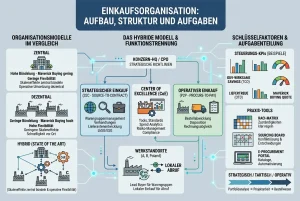
The hybrid model breaks with this pattern. It connects two worlds:
- The strategic component (Consulting): In-depth spend analyses, category segmentation, process audits and the definition of a tailor-made purchasing strategy.
- The operational component (Implementation & Interim): The consultant leaves their ivory tower, sits down at the negotiating table, holds supplier discussions, implements e-procurement tools, and coaches the internal team directly „on the job“.
Analysis & Strategy (classic consulting approach) + Hands-on Implementation (interim & negotiation expertise) = Hybrid Model (sustainable margin improvement & knowledge transfer)
„An excellent purchasing strategy only unfolds its value when it is consistently and skilfully implemented directly in the marketplace through negotiation.“
Would you like a brief consultation on this?
4. The core tasks of a purchasing consultant in detail
A. Spend Analysis & Identification of „Quick Wins“
A consultant delves deep into the ERP data. Where is the money flowing? Which C-parts are causing disproportionately high process costs? A structured commodity group analysis quickly identifies leverageable potential (quick wins) that often refinance the project within the first few weeks.
B. Strategic supplier negotiation
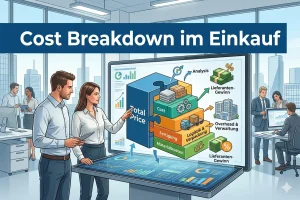
Negotiation is a craft and psychology. The consultant prepares negotiations based on data (target cost analyses, Cost Breakdowns), conducts Requests for Proposals (RFPs) and employs proven negotiation tactics. In the hybrid model, he either negotiates himself or acts as a coach in the background.
C. Digitalisation & Process Optimisation
Many medium-sized purchasing departments are drowning in administrative work. The purchasing consultant introduces lean e-procurement systems, establishes automated approval processes, and ensures that the team can once again focus on strategic tasks.
D. Risk Management & Compliance
Supplier failures can bring entire production processes to a halt. The consultant establishes active risk management (dual sourcing strategies, financial audits of key suppliers) and ensures that legal requirements (sustainability, ESG, LLSG) be met pragmatically.
5. Direct Comparison: Traditional Consulting vs. Hybrid Model
- Focus
- Classic Buying Advice: Concept, Analysis, Strategy Paper.
- Hybrid Model: Strategy combined with immediate operational implementation.
- Purchase role
- Classic shopping consultation: Acts as an external observer and analyst.
- Hybrid Model: Works as an integrated partner and an active „doer“ on-site.
- Satisfaction guaranteed
- Classic shopping advice: Little impact on the actual implementation of theory.
- Hybrid model: Very high, as the consultant is actively liable for the implementation of the measures.
- Know-how Transfer
- Classic shopping advice: Usually only happens sporadically or not at all.
- Hybrid Model: Intensive, daily coaching for the existing purchasing team.
- Fee structure
- Classic purchasing advice: Generally time-based using daily rates.
- Hybrid model: Often linked to performance-oriented components (e.g. gain-share models).
6. Methodology in Detail: The TCO Approach to Holistic Cost Reduction
In practice, medium-sized companies often make the mistake of focusing solely on the nominal purchase price in negotiations. An experienced purchasing consultant broadens the perspective to the Total Cost of Ownership (TCO) – that is, the total cost of ownership of a product or service.
The TCO approach uncovers hidden cost factors that go far beyond the purchase price alone:
- Logistics & Transport: Inexpensive suppliers in distant countries often cause significant additional costs due to long transport routes, customs clearance, or necessary safety stocks.
- Quality defects and scrap: A seemingly cheap component can trigger massive rework costs or even waves of customer complaints due to high error rates in production.
- Process and administrative costs: The manual handling of countless small orders (C-parts) from dozens of different suppliers ties up valuable working time and drives up the process costs per order.
- Maintenance & Disposal: The longevity, energy consumption, and subsequent disposal costs of machinery and equipment must be factored in from the outset of procurement.
A purchasing consultant analyses these flows holistically. The aim is to sustainably reduce the total actual costs through optimised contracts, supplier consolidation and process standardisation, rather than just celebrating short-term paper victories in purchase prices.
„The cheapest price is rarely the most economical – the true costs of a procurement decision only become apparent during daily operation.“
7. Case Study: Increasing Efficiency and Savings in Industrial Purchasing
The project example of a medium-sized mechanical engineering company with an annual turnover of around 45 million euros shows how the hybrid model is unfolding in practice:
- The starting situation: Rising material costs for special assemblies and custom parts were massively impacting the profit margin. The three-person purchasing department was completely occupied by the purely operational processing of hundreds of daily C-part orders. There was simply no room for strategic market analyses or structured tenders.
- The levers of the purchasing consultant
- Creating transparency: In the first step, ERP data from the last two years was cleaned and structured. The consultant filtered out the lever product groups using an ABC analysis.
- Streamlining processes: By immediately implementing a lean, digital e-procurement tool for standard and C-parts, staff were able to reduce the time taken to process orders by over 35 %. This freed up valuable time for the team to focus on strategic tasks.
- Bundling and structured tender process: Demand for the core assemblies was bundled and re-marketed through a professional tender setup.
- Operatives Coaching & Negotiation: The consultant took the lead on key negotiations and simultaneously coached the internal team using real-life scenarios.
- The measurable result: following a six-month project, sustainable savings of 11.2 % were achieved across all focus product groups. Process costs in the C-parts sector fell significantly. The return on investment (ROI) for the consultancy project was achieved after just 3.5 months – whilst the in-house team is now able to continue these processes independently on a permanent basis.
8. E-E-A-T Criteria: How do you recognise an excellent consultant?
To ensure the consulting project doesn't become an expensive misunderstanding, you should pay attention to the following quality characteristics when making your selection (Experience, Expertise, Authoritativeness, Trustworthiness):
- Industry experience: Has the consultant demonstrably worked in the mid-sized business sector? The dynamics in owner-managed companies are completely different from those in anonymous corporations.
- Expertise: Can the consultant provide reference projects in technical purchasing, the strategic lead buyer concept, or digitalisation?
- Transparency & Independence (Trustworthiness): A reputable consultant operates independently of specific software vendors or suppliers. Their recommendations must be solely in the best interests of your company.
- Pragmatism: In the mid-market, results matter, not the prettiest framework. Look for consultants with a „roll-up-your-sleeves“ mentality.
9. Conclusion: Why a purchasing consultant saves more than just costs for small and medium-sized businesses
A modern Purchasing consultant for SMEs is not purely a „price killer“. Anyone who simply drives down prices damages long-term partnerships with suppliers and jeopardises security of supply.
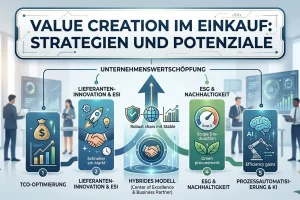
The hybrid model shows that true value creation lies in the combination of rapid cost reduction, digital transformation, and empowering one's own employees. This transforms procurement from a pure cost centre into a genuine value driver and a strategic competitive advantage for your company.
10. FAQ: Frequently asked questions about the purchasing consultant for SMEs
When is a purchasing consultant worthwhile for medium-sized businesses?
A purchasing consultant generally pays off from an external purchasing volume (spend) of approx. 5 million Euros per year. The external input is also extremely valuable for upcoming large projects, acute supply bottlenecks, or a planned restructuring of purchasing.
What does a shopping consultant cost?
Remuneration varies depending on the model. In addition to classic daily rates (which range from €1,200 to €2,500 depending on seniority), many consultants offer performance-related components (gain share) in the hybrid model. In this model, the fee is refinanced directly from the realised savings.
How long does a typical project take?
A classic optimisation project in a hybrid model takes between 3 and 9 months. Following a 2 to 4-week analysis phase, there is a direct implementation and negotiation phase, followed by stabilisation and team coaching.
Do I lose control over my suppliers by using a consultant?
No, quite the opposite. The consultant acts as a catalyst and co-driver. The final contracts and the long-term relationship remain entirely in your company's hands. The goal of the hybrid model is to strengthen your own organisation, not to make it permanently dependent.