


First and foremost:
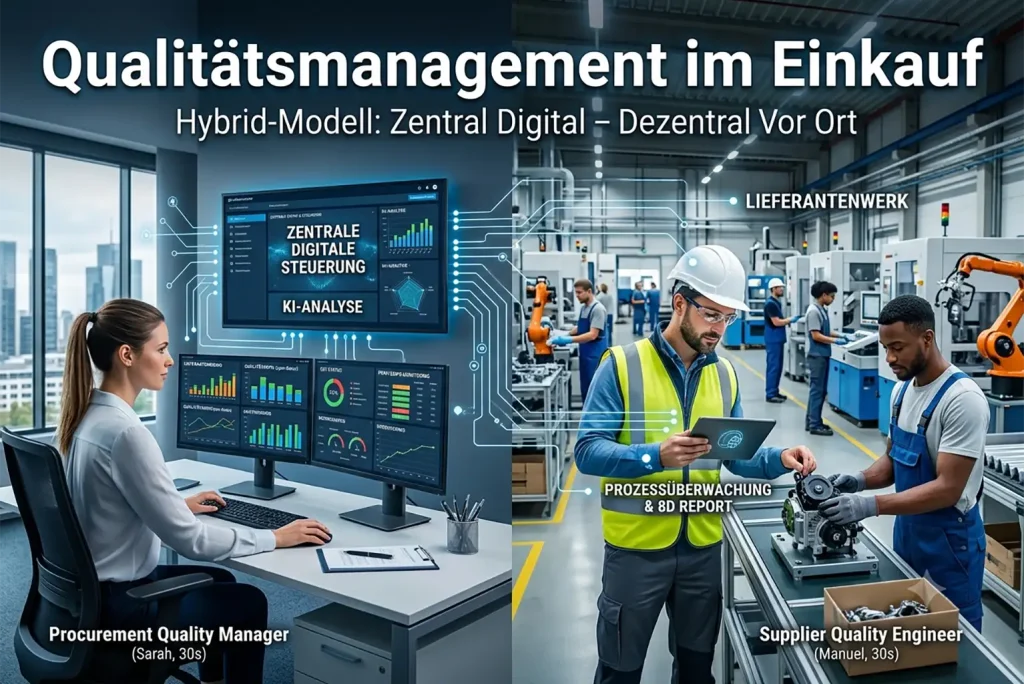
A strategic Quality management (QM) in purchasing ensures product quality right at the root of the supply chain, minimises production losses and reduces overall costsTotal Cost of Ownershipdrastic. By using a hybrid model – the combination of central digital control and agile, decentralised implementation on-site – companies can react flexibly to market changes while simultaneously guaranteeing the highest compliance and quality standards.
Key Facts on Quality Management in Purchasing
- Definition: Purchasing QM encompasses all planning, controlling, and monitoring measures to ensure the quality of externally procured goods and services.
- The Hybrid Model: Combines standardised, AI-supported data analyses (central) with bespoke supplier developments and on-site audits (decentralised).
- Core objectives: Risk minimisation (supply failures), cost reduction (scrap reduction), compliance adherence (e.g. LkSG) and establishment of a zero-defect culture.
- Key processes: Supplier qualification, Quality assurance agreements (QAA), Production part approval process (PPAP/EMPB) and complaint management (8D report).
1. Definition & Standards: What does Quality Management in Procurement mean?
While classical QM often focuses on the internal Production processes focused, quality management in purchasing is implemented significantly earlier: at the source of the value chain.
„Real quality isn't just checked in our own production – it's created together with our partners right at the root of the supply chain.“
The normative framework (ISO 9001 & IATF 16949)
From the perspective of international standards, this area is strictly regulated. Anyone wishing to act in an audit-compliant manner must adhere to clear guidelines:
- ISO 9001 (Chapter 8.4): This core standard explicitly requires „Control of externally provided processes, products and services“. Organisations must determine and apply criteria for the evaluation, selection, performance monitoring and re-evaluation of external providers.
- The IATF 16949, the global quality standard for the automotive industry, significantly tightens these requirements once again and, among other things, demands a seamless system for supplier performance evaluation as well as binding product and process approvals.
2. The Hybrid Model in Modern QM
In a volatile global economy, purely centralised or purely decentralised QM structures are reaching their limits. Modern pioneering companies are therefore adopting a hybrid model.
This model combines the best of both worlds:
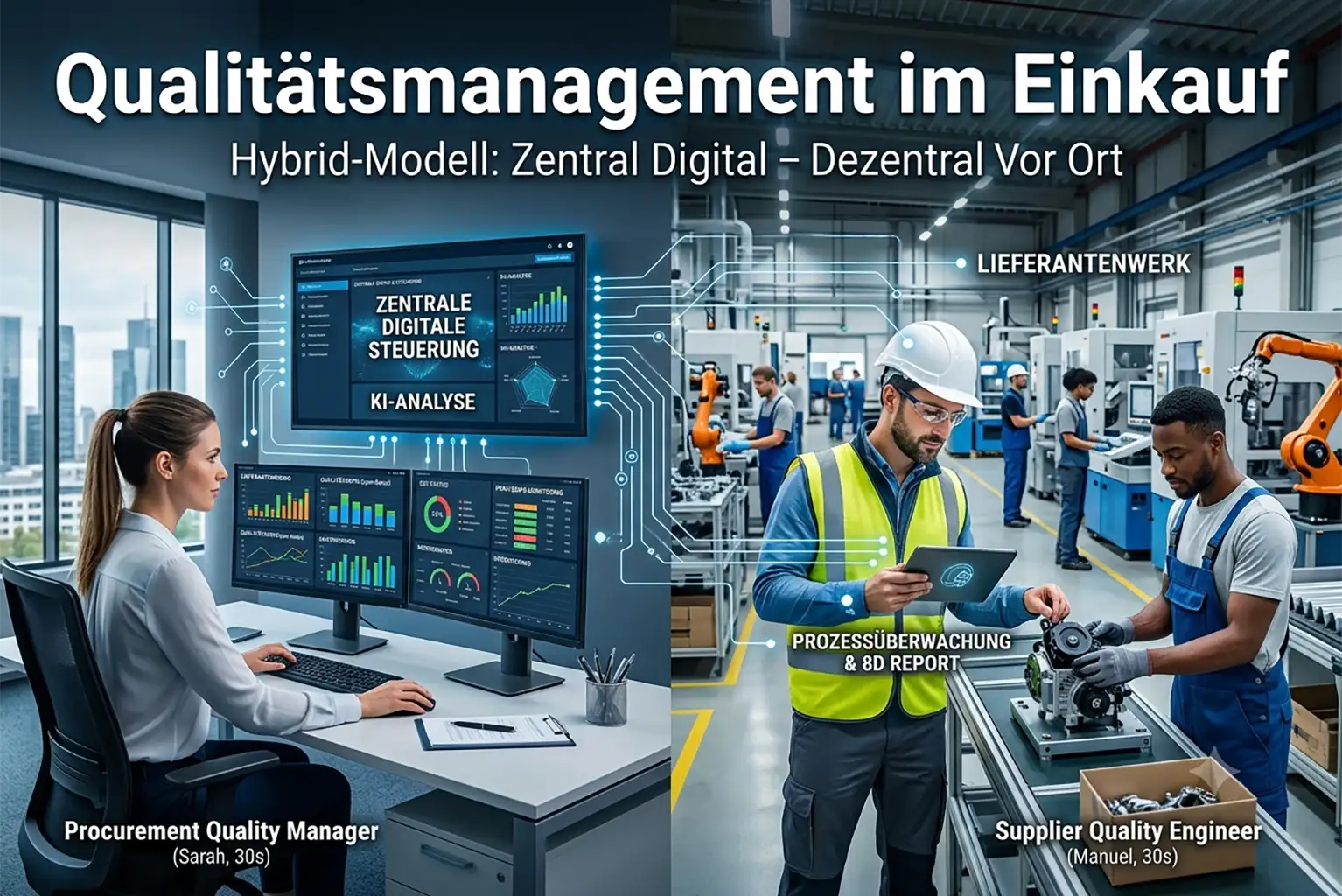
- Central Digital Excellence: A central unit controls global quality standards, utilises AI-powered dashboards for risk analysis, and manages standardised contracts such as Quality Assurance Agreements (QAAs).
- Decentralised, agile execution: Local Quality Management engineers and buyers act flexibly directly on-site with the supplier. They conduct ad-hoc audits, resolve acute quality problems, and develop suppliers individually.
Comparison: Traditional vs. Hybrid Model
- Control
- Traditional QM: Rigid, purely reactive towards errors.
- Modern Hybrid Model: Agile, Preventive, and Data-Driven.
- Technology
- Traditional QM: Manual Excel lists and isolated siloed data.
- Modern Hybrid Model: Cloud-based Supplier Portal and AI Early Warning Systems.
- Focus
- Traditional QM: Pure price control and subsequent goods receipt inspection.
- Modern Hybrid Model: Total Cost of Ownership (TCO) and Partnership Development.
- Flexibility:
- Traditional QM: Low adaptability in supply chain disruptions.
- Modern Hybrid Model: High resilience through decentralised, flexible networks.
3. Strategic and operational objectives
The introduction of structured QM in procurement primarily aims to secure the company's value creation. The objectives can be divided into three dimensions:
- Risk mitigation: avoidance of production line stoppages, recalls, and reputational damage due to faulty supplier parts.
- Cost Efficiency (TCO): Reduction of incoming goods inspection costs. Ideally, excellent supplier QM enables the „skip-to-stock“ procedure (direct delivery to production without interim inspection).
- Sustainability & Compliance: Ensuring legal requirements, such as the German Supply Chain Due Diligence Act (LkSG).
Would you like a brief consultation on this?
4. The QM process in procurement: step by step
A more stable QM process in procurement is divided into four chronological core phases. This control loop is based on the classic PDCA cycle (Plan-Do-Check-Act).
The process at a glance:
1. Qualification (Supplier Selection & Auditing)
↓
2. Agreement (Legal & technical framework via QSV)
↓
3. Approval (Sample approval via PPAP / EMPB)
↓
4. Monitoring & 8D (Series Monitoring & Complaint Management)
Step 1: Supplier Selection and Qualification (Plan)
Before the first order is placed, the supplier must be thoroughly vetted. This is done through self-disclosures, financial ratings, and above all, supplier audits (e.g., according to VDA 6.3 or ISO 9001).
Step 2: Quality Assurance Agreements - QAA (Do)
The QSV is the legal and technical framework. It clearly fixes defect tolerances (AQL values), testing procedures, documentation obligations, and liability issues.
Stage 3: Product and Process Release (Check)
Established in the automotive and manufacturing industries: sampling according to PPAP (Production Part Approval Process) or EMPB (Initial Sample Inspection Report). The supplier must prove under series production conditions that they can consistently deliver the required quality.
Step 4: Series Monitoring & Complaint Management (Act)
In ongoing operations, quality indicators (e.g. ppm rates, on-time delivery) are continuously monitored. Should errors nevertheless occur, the structured complaints management process is applied using the 8D report to sustainably eliminate the causes (Root Cause Analysis).
5. Deep Dive: Predictive Quality Management & AI in Procurement
Digitalisation is taking quality management in purchasing to the next evolutionary stage: the shift from reaction to prevention. While traditional QM only raises the alarm when faulty goods arrive at the warehouse, a predictive approach uses artificial intelligence and big data.
How does predictive QM work in the practice of the hybrid model?
- Early warning systems through external data streams: The central AI unit permanently scans global data sources – such as weather reports, geopolitical events, strikes or financial news. If bottlenecks or quality risks are threatening at a sub-supplier due to a shortage of raw materials, the system issues a proactive alarm.
- Machine learning in claims management: Algorithms analyse historical complaint data (8D reports) and link them to the supplier's current production data. The system recognises patterns and predicts the probability that a specific batch will show deviations.
- Dynamic Audit Intervals: Instead of rigidly auditing every supplier every 24 months, the software calculates a dynamic risk score. Only suppliers with increased risk are scheduled for on-site audits by the decentralised QM teams. This conserves resources and focuses manpower where it is truly needed.
6. Practical example: The hybrid model in real-world use
To make the theory tangible, let's consider the fictional but absolutely realistic case of TechDrive GmbH, a manufacturer of e-bike components.
- The initial situation: During the final assembly of engines, there is a sudden increase in functional failures of a supplied sensor. A line stoppage is imminent.
- Step 1 – Central Detection (Central): TechDrive's central cloud-based CAQ system registers the sudden increase in the ppm rate for this specific component in real-time. The central quality department isolates the affected batch and blocks further deliveries of this type in the system.
- Step 2 – Agile On-Site Intervention (Decentralised): Instead of lengthy email exchanges, a decentralised Supplier Quality Engineer (SQE), already located in the supplier's region, is sent directly to the supplier's plant.
- Step 3 – Collaborative Problem-Solving: On-site, the SQE dutifully identified that a calibration machine exhibited minor tolerance deviations following maintenance at the supplier's premises. The machine was immediately recalibrated.
- Step 4 – Sustainable resolution: The supplier initiates a 100% inspection of the next batches and documents the corrective actions in the 8D report. Thanks to the hybrid structure (rapid central data verification + immediate local action), the fault was rectified within 24 hours and a production line stoppage was averted.
7. Quick Checklist: Hybrid Purchasing QM in 5 Steps
Do you want to take your procurement quality management to the next level? Use this compact checklist as a roadmap for transformation:
- [ ] 1. Create a data foundation: Integrate your ERP and CAQ systems into a central, cloud-based supplier portal to gain real-time transparency across all quality data.
- [ ] 2. Define risk profiles: Cluster your suppliers by relevance (A, B, C parts) and assign a dynamic risk profile to each partner.
- [ ] 3. Modernise QSV Standards: Revise existing quality assurance agreements and embed clear obligations for digital data transmission and agile escalation levels.
- [ ] 4. Establish decentralised hubs: Station Supplier Quality Engineers (SQEs) directly in the most strategically important procurement regions to reduce travel times for audits and complaints to virtually zero.
- [ ] 5. Close the prevention loop: Use initial AI-powered analysis tools to predict future quality defects from historical 8D reports and market data, rather than just managing them retrospectively.
8. E-E-A-T Practical Tips for Successful Implementation
As experienced professionals with practical expertise, we know that Quality Management in procurement must not be purely about paper compliance. To ensure successful implementation, you should consider the following points:
💡 Practical Tip: Partnership instead of a hard line
Consider your core suppliers as partners. If a supplier has quality issues, send an interdisciplinary team (procurement & QM) to jointly optimise processes (supplier development) rather than just threatening penalties. This secures capacity in the long term.
- Apply the 80/20 rule (Pareto principle): Focus your quality management resources (audits, in-depth inspections) on the 20% of suppliers responsible for 80% of the procurement volume or technological risk (A-suppliers).
- Digitise goods receipt: Rely on modern ERP and CAQ systems that report deviations to purchasing in real time.
9. Conclusion on Quality Management in Procurement
Quality management in purchasing is no longer an optional „nice-to-have“ but an existential business driver in the age of global and vulnerable supply chains. The hybrid model offers the perfect balance between data-based efficiency and on-site human agility. Those who digitise and shape their processes from qualification to complaint management in a collaborative manner will reduce their costs, increase product quality and secure a clear competitive advantage.
„In a volatile economy, quality management is no longer just a control body, but the digital and human foundation for resilient value creation.“
Companies that consistently take this step make their global supply chains sustainably resilient against unpredictable market disruptions and volatile commodity markets. Ultimately, procurement is thereby transformed from a pure cost centre into a strategic value-adding partner – because true product quality is not created in one's own factory, but already begins with the supplier.
10. FAQ – Frequently Asked Questions on Quality Management in Purchasing
What is the difference between quality assurance (QA) and quality management (QM) in procurement?
Quality Assurance (QA) is product-related and reactive (e.g., measuring a component upon receipt). Quality Management (QM) in purchasing is process-oriented, preventive, and holistic (e.g., optimising production processes at the supplier to prevent errors from occurring in the first place).
Is a QSV (Quality Assurance Agreement) legally required?
No, a QSV is not legally mandatory. However, it is extremely common in the B2B sector and strongly recommended, as it clearly regulates liability risks in the event of product defects (according to the Product Liability Act) and can shift the burden of proof in favour of the buyer.
How is the success of QM in procurement measured?
Success can be measured through clear Key Performance Indicators (KPIs). The most important metrics are the ppm rate (parts per million – defective parts per million supplied parts), the complaint rate, rework and scrap costs, and supplier audit compliance rates.
What role does the Supply Chain Due Diligence Act (LkSG) play in purchasing quality management?
The LkSG expands traditional procurement quality management to include social and environmental criteria. Established QM processes – such as supplier self-declarations, risk analyses, and on-site audits – are now directly used to also monitor human rights and environmental due diligence obligations. As a result, quality assurance and compliance assurance are merging into a single unit.