



Key Facts on AI for Buyers
- Efficiency boost: Automation of time-consuming routine processes such as invoice verification, master data maintenance and order initiation.
- Predictive insights: AI-powered market analyses forecast price developments and optimal purchasing times.
- Proactive risk management: Early warning systems scan global data sources to report supply chain bottlenecks and geopolitical risks before they impact production.
- Valuable hybrid model: The symbiosis of human negotiation expertise and AI-supported data analysis maximises ROI.
Table of Contents
- 1. The Status Quo: Why Procurement Needs AI Support
- 2. The key benefits of AI for procurement in detail
- 3. Concrete Use Cases and Direct Comparison
- 4. The Hybrid Model: Humans and Machines as a Successful Team
- 5. Mastering Implementation Challenges
- 6. Technological Differentiation: Analytical vs. Generative AI in the Procurement Process
- 7. Practical application example: Risk mitigation in global procurement
- 8. Measuring Success and Sustainability: KPIs, ESG, and IT Infrastructure
- 9. Conclusion: The measurable benefit of AI for buyers
- 10. FAQ: Important questions about using AI for buyers
1. The Status Quo: Why Procurement Needs AI Support

This is where artificial intelligence comes in. It doesn't act as a replacement for humans, but as a highly developed assistant that analyses vast amounts of data in seconds, recognises patterns, and delivers concrete recommendations for action.
2. The key benefits of AI for procurement in detail
The implementation of AI tools in procurement brings measurable strategic and financial benefits.
Time and cost savings through automation
Routine tasks such as reviewing quotes, reconciling delivery notes, or maintaining supplier master data are fully automated with AI. This significantly reduces lead times in the procure-to-pay process and lowers the error rate to virtually zero.
Maximum transparency in donation management
AI systems can automatically categorise and cleanse unstructured spend data. Buyers can immediately see where Maverick Buying (uncontrolled purchasing outside of established channels) is happening and where consolidation potential remains untapped.
Democratisation of knowledge
Through Natural Language Processing (NLP) and Large Language Models (LLMs), buyers can have contracts and complex tender documents searched for specific clauses, liability risks, or price adjustment mechanisms in seconds.
3. Concrete Use Cases and Direct Comparison
To clearly illustrate the difference between traditional and AI-powered mobile shopping, the following overview shows the direct differences in daily work:
- Market analysis:
- Traditional: Manual research and a focus on historical data.
- AI-powered: Real-time monitoring of global markets and predictive pricing trends.
- Risk Management
- Traditional: Reactive damage limitation only after a supply failure occurs.
- AI-powered: Proactive early warning of adverse weather, strikes, or geopolitical risks.
- Contract analysis:
- Traditional: Manual and time-consuming review of extensive documents.
- AI-powered: Automatic, split-second check for compliance and liability risks.
- Supplier assessment
- Traditional: Subjective and often incomplete manual scorecards.
- AI-powered: Real-time data-driven 360-degree performance analysis.
Predictive Sourcing and Price Forecasting
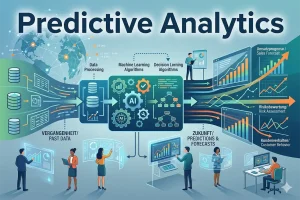
AI algorithms analyse historical data, commodity exchanges, weather reports and geopolitical events. The result: precise forecasts on how commodity prices will develop. This allows the buyer to know exactly whether they should buy now or wait to conclude the contract.
Automated Negotiation
For C-parts (low value, high effort), AI bots are already being used. These independently negotiate prices and delivery conditions with hundreds of suppliers simultaneously – strictly within the guidelines defined by the company.
Would you like a brief consultation on this?


4. The Hybrid Model: Humans and Machines as a Successful Team
An AI project in procurement fails if you try to completely rationalise out the human factor. The hybrid model (human-in-the-loop) is the key to success:
AI takes over data analysis, pattern recognition and repetitive grunt work. The human buyer uses these insights to make strategic decisions, maintain long-term supplier relationships and bring empathy and a delicate touch to critical negotiations.
5. Mastering Implementation Challenges
Where there is light, there is also shadow. The introduction of AI in Purchasing requires careful preparation:
- Data quality („Garbage in, Garbage out“): AI only works with clean data. If master data in the ERP system is incomplete, the AI predictions will also be unusable. Prior data cleansing is mandatory.
- Change Management: Buyers need to be trained and concerns about job loss allayed. The focus should be on how AI eases daily work.
- Data Protection and Compliance: When using public AI tools, internal supplier data or confidential pricing structures must not be disclosed externally. The use of secure, company-internal instances is essential.
6. Technological Differentiation: Analytical vs. Generative AI in the Procurement Process
For a deeper understanding of the system landscape in modern procurement, it is crucial to differentiate between the two primary technological pillars of artificial intelligence. Both fulfil entirely different tasks in everyday operational and strategic life:
Analytical AI (pattern recognition and mathematical forecasting)
This form of AI is based on machine learning and statistical models. It processes structured data from ERP and SCM systems.
- Application areas: Spend analyses, outlier detection in order prices, mathematical algorithms for optimal safety stocks, and predictive price forecasts on commodity exchanges.
- Strength: Extremely precise processing of large numerical datasets and the identification of complex trends that remain invisible to the human eye in Excel spreadsheets.
Generative AI (Text Comprehension and Interaction)
This technology is based on Large Language Models (LLMs) and is capable of understanding, linking, and independently generating new content from unstructured, text-based information.
- Application area: Automated evaluation of legal contract documents, creation of tailored RFPs (tender texts), and AI-supported correspondence with suppliers regarding complaints.
- Strength: Accessible access to unstructured knowledge through natural language input (Natural Language Processing).
Only by linking both worlds in the purchasing process can a comprehensive assistance system be created that can both forecast figures and legally review the associated contracts.
7. Practical application example: Risk mitigation in global procurement
What is the specific process when a medium-sized manufacturing company uses AI to secure its supply chain? The following scenario illustrates the process in a hybrid model:
- The initial situation: A car parts manufacturer sources a critical electronic component from a specialised supplier in an export-heavy region of Asia. A failure of this part would mean a standstill in their own production line.
- AI Impetus (Real-time Monitoring): A severe typhoon is heading towards the coastal region of the Asian supplier. The AI-powered risk management tool captures worldwide weather data and satellite reports in real time. It automatically links these environmental factors with the geo-data of the supplier structure in the ERP system.
- The proactive alert: The system calculates the risk of a delivery delay for the next two weeks at over 80 %. It immediately sends an automated notification to the relevant buyer’s dashboard – including a pre-formulated suggested solution.
- The automated alternative plan: In parallel, the analytical AI scanned the internal product group data and identified two already qualified European secondary suppliers (dual sourcing) who have spare production capacity for this component.
- The human added value: The purchaser merely needs to check the proposed relocation of order volumes and approve it with a mouse click. As the generative AI has simultaneously pre-drafted the necessary amendment agreements and notifications in a legally compliant manner, no valuable time is lost.
This example demonstrates practically how the combination of algorithmic speed and human decision-making expertise prevents costly production failures even before the actual storm reaches the main supplier's factory.
8. Measuring Success and Sustainability: KPIs, ESG, and IT Infrastructure
To ensure the long-term benefit of AI systems in procurement and make it transparent for management, three strategic pillars must be linked:
Measurability through clear purchasing KPIs
The success of an AI implementation can be directly gauged by hard metrics:
- Lead time for purchase requisitions: AI-powered approval processes often reduce the time from request to order by more than half.
- Maverick Buying Quote: Uncontrolled purchases outside of framework agreements decrease drastically due to automatic alerts for deviations.
- Contract Compliance: AI continuously monitors whether agreed discounts, deadlines, and bonus tiers are actually adhered to and invoiced by suppliers.
Sustainability and ESG criteria (Scope 3)
Modern procurement doesn't stop at price. AI-powered analysis tools scan global supply chains down to the deepest supplier levels to make CO2 footprints transparent. This not only facilitates ESG reporting but also proactively secures companies against legal risks from the Supply Chain Due Diligence Act (LkSG).
Seamless integration into the IT infrastructure
The maximum benefit is only realised when AI tools do not form an isolated silo. Modern AI systems connect directly to leading ERP and SCM landscapes (such as SAP, Coupa, or d.velop) via standardised interfaces (APIs). Only through this seamless real-time data flow do algorithms work flawlessly and feed purchasing managers' dashboards with reliable insights.
9. Conclusion: The measurable benefit of AI for buyers
Artificial intelligence in procurement is no longer a future scenario, but a lived reality. It takes the burden of administrative routine off buyers and equips them with the tools to act as true strategic advisors within the company. Those who leverage the opportunities of predictive sourcing, automated risk management, and AI-supported contract analysis today will secure their company's resilience and profitability for tomorrow. The actual benefit of AI for Buyers manifests itself primarily in the time gained for value-adding core tasks, as well as in a transparent, legally compliant, and measurable supply chain structure.
10. FAQ: Important questions about using AI for buyers
Will AI replace the human buyer in the future?
No. AI will not replace buyers, but buyers who use AI will replace those who do not. Strategic relationship management, ethical evaluations and complex negotiations will continue to require human empathy and intuition.
The use of AI in purchasing becomes worthwhile from a certain company size.
AI tools are no longer reserved for large corporations thanks to SaaS (Software-as-a-Service) models. Medium-sized companies are also benefiting enormously, particularly in automated invoice reconciliation and supply chain risk monitoring.
How does AI help with compliance with the Supply Chain Due Diligence Act (LkSG)?
AI can continuously scan thousands of global news sources, social media posts, and official reports. As soon as there are indications of human rights violations or environmental infringements by a supplier (or their upstream suppliers), the system immediately raises an alert.
What data quality is required for the successful use of AI?
Very high. The accuracy of any AI analysis depends directly on the quality of the underlying data. Before implementing AI systems, companies should therefore cleanse their master supplier data and ERP data to avoid false forecasts („garbage in, garbage out“).