


First and foremost:
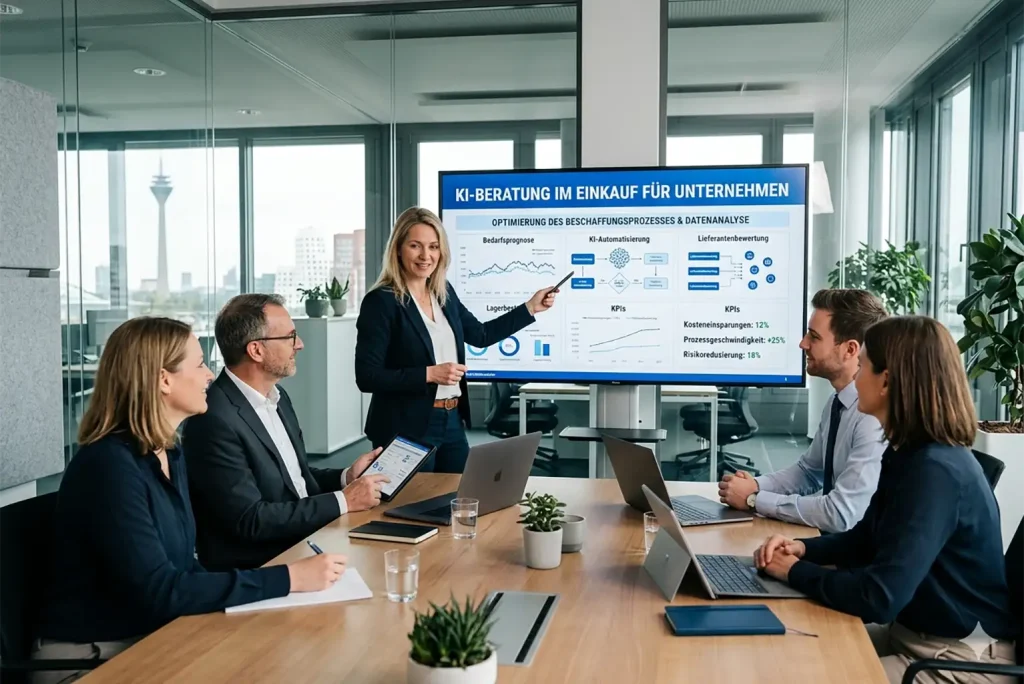
Artificial intelligence in procurement is not purely a software question, but rather a strategic transformation project. Companies that have a specialised AI Consulting use, overcome critical data silos (such as unstructured free-text data and duplicate vendor records) up to 60% faster, and ensure regulatory compliance in accordance with the EU AI Act and achieve demonstrable reductions in merchandise and process costs. Those who attempt implementation purely internally or without in-depth data engineering run the risk of expensive misplaced investments in incompatible isolated solutions.
Key Facts on AI Consulting in Procurement
- Core objective: Uncovering hidden savings potential through automated spend analysis, proactive risk management, and increasing the no-touch order rate.
- The role of consulting: System audits (e.g. SAP S/4HANA, Microsoft Dynamics), data cleansing using entity resolution, tool selection and legal security.
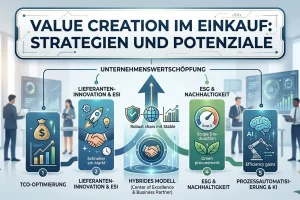
- The Strategic Lever: The Hybrid Model – the productive symbiosis of mathematical precision (AI) and strategic relationship management (human).
- Measurable ROI: a reduction in maverick buying of up to 10% (%), a significant increase in process efficiency, and the early prevention of supply chain disruptions.
1. The Status Quo: Undetected Data Entropy in Procurement
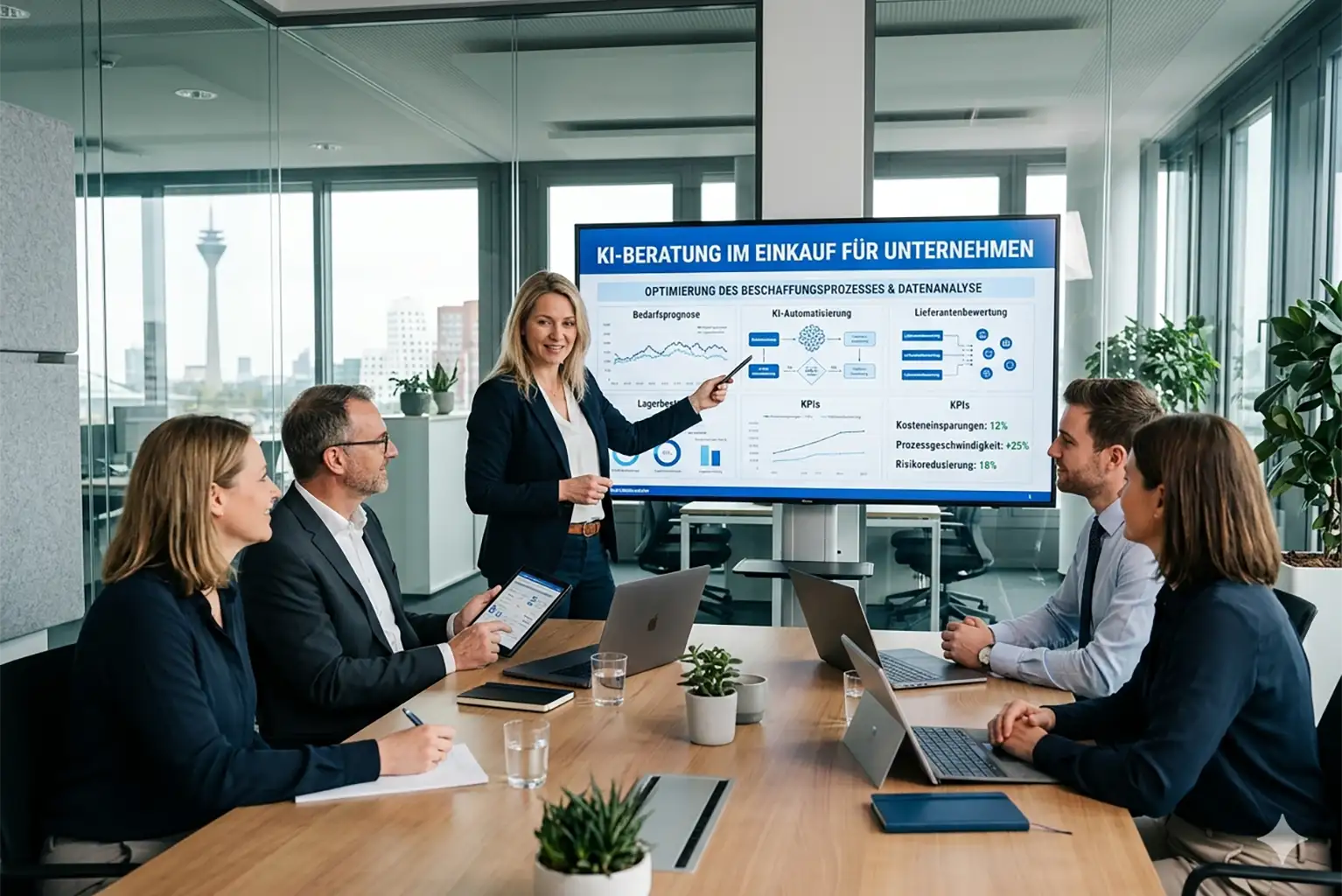
In most ERP systems, „dark purchasing“ prevails:
- Master data is incomplete, Incoterms are inconsistently maintained, and commodity codes (such as eCl@ss or UNSPSC) are often ignored by operational buyers.
- A significant portion of purchasing volume is lost in unstructured free-text fields.
Pure software providers often promise a quick „plug-and-play“ fix through AI. However, reality shows that without prior, expert AI consulting during procurement, which methodically breaks down these data silos, you are merely feeding expensive algorithms with bad data („Garbage in, Garbage out“). The result is flawed forecasts and untapped savings potential.
„Artificial intelligence will not replace the buyer. But the buyer who uses AI will eventually replace the buyer who does not.“
2. What does AI consulting deliver? The hybrid model and governance
A professional AI consultancy acts as a strategic architect. It assesses technological feasibility, calculates the business case, and embeds the hybrid model within your corporate culture.
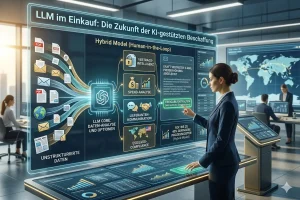
The hybrid model in practice
AI in procurement does not mean replacing humans, but freeing them from repetitive cognitive burdens. While AI correlates millions of lines of global market data, contracts and logistics notifications within seconds, the strategic buyer focuses on what machines cannot do: empathetic negotiation, geopolitical situation assessments and building resilient supplier relationships.
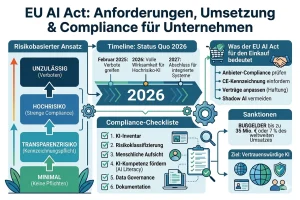
Compliance and the EU AI Act
A critical core area of modern consulting is AI Governance. Since the EU AI Act came into force, companies must carefully examine which risk class their AI applications fall into.
If systems, for example, are used for fully automated assessments, filtering classifications or supplier credit checks, transparency obligations and documentation requirements can quickly apply. Specialised consultancy ensures that your systems are „compliant“ and protects the company from draconian fines.
3. Key Use Cases for AI in Procurement (Mobile-Optimised)
To ensure optimal readability on all mobile devices, here are the most important, tried-and-tested AI application fields, presented without cumbersome table structures:
- Automated Spend Analysis
- Technologie: Natural Language Processing (NLP) & Machine Learning.
- Expert benefits: Algorithms clean up vendor master data via entity resolution (e.g., merging „Müller GmbH“, „Müller Co.“, and „Müller-Gruppe“). Free text is automatically assigned to the correct product groups. The result is a crystal-clear, consolidated „Spend Cube“.
- AI-powered contract management (Contract Analytics)
- Technology: Large Language Models (LLMs) & Semantic Search.
- Expert benefit: Thousands of existing contracts are scanned in real-time for hidden risks, such as unfavourable price adjustment clauses, liability risks, or automatic renewal periods, and compared against in-house standard purchasing terms.
- Predictive Sourcing and Price Forecasting
- Technology: Predictive time series analysis and neural networks.
- Expert benefit: The AI correlates internal needs with external indicators (e.g., commodity exchanges, energy prices, freight rates). Buyers receive proactive signals for the mathematically optimal procurement timing.
- Supplier risk management
- Technology: Big Data Crawling & Sentiment Analysis.
- Expert benefits: Continuous screening of global news, social media, weather, and geo-data. Impending strikes, insolvencies, or natural disasters within the deep, multi-tiered supplier network (Tier-2 to Tier-N) are reported before your own production line is at risk of stoppage.
Would you like a brief consultation on this?

4. Deep Dive: Predictive vs. Generative AI – The Technological Crossroads
For a successful transformation, companies must understand that „AI“ is not a homogenous tool. Sound advice strictly distinguishes between two main technological currents that perform entirely different tasks in procurement:
Predictive AI: A look into the crystal ball of numbers
Predictive AI is based on advanced statistics and machine learning. It requires structured, historical data to recognise patterns and calculate probabilities for the future.
- Area of application: Prediction of scrap rates, determination of optimal safety stocks, and price trend forecasts.
- The hurdle: If the historical data is corrupted due to system changes or manual input errors, the mathematical models will fail.
Generative AI: The Logical Text and Process Catalyst
Generative AI (LLMs) works contextually and processes unstructured data (texts, PDFs, emails). It doesn't „calculate“ hard trends, but rather understands semantic connections.
- Application area: Automated creation of tailor-made RFPs (Request for Proposal), summarisation of complex supplier offers and translation of negotiation scripts.
- The hurdle: Without clean prompt engineering and closed enterprise instances, information hallucinations and the unintended outflow of sensitive company know-how into public training data are a risk.
Deep-dive conclusion: While predictive AI tells the buyer what they should buy and at what price, generative AI helps to finalise the purchasing process and contract drafting flawlessly and in record time.
5. Practical Example: How a medium-sized company transformed its procurement
What does the measurable success of strategic AI consulting look like? Let's consider the case study of a medium-sized mechanical engineering company with around 450 employees and an annual purchasing volume of 80 million euros.
The challenge
The strategic procurement team (3 staff members) was 70% tied up with operational data consolidation in Excel. A high proportion of maverick buying (unauthorised purchases outside the framework agreement) was driving up costs. Furthermore, inaccurate vendor master data was resulting in incomplete supplier evaluations.
The implementation by the AI consultancy
Within a 6-month project, the consultancy implemented a three-stage strategy:
- Data Cleaning: Use of an AI pipeline for automated cleaning and clustering of all purchasing data from the last two years.
- API Integration: Connection of a specialised, lean AI dashboard via REST API to the existing ERP system for real-time monitoring of purchase requisitions.
- Enablement: Intensive training for the team on how to handle AI-generated datasets for supplier negotiations.
The measurable outcome
- Maverick buying rate: Reduced from 18 % to under 4 % through an automated AI early-warning system for incorrect orders.
- No-touch order rate: 35% increase in orders processed fully automatically and without errors.
- Direct savings: Thanks to the consolidated database, cost reductions of 8.5 % were achieved in the renegotiated product groups. The return on investment (ROI) for the consultancy costs was achieved as early as the fifth month after go-live.
6. Step by Step: The Timetable-Free Collapse? The Structured Roadmap
To prevent the AI integration from sinking into expensive one-off solutions, excellent consulting will guide your company through a clear governance roadmap:
„Artificial intelligence is not a magic wand, but a precise mirror of one's own data quality. Only methodical preparation makes modern technology profitable in the B2B environment.“
Step 1: The IT Architecture and Data Audit
Review of existing infrastructure. Are the ERP systems (e.g. SAP S/4HANA Cloud or legacy systems) ready for real-time data querying? Where are the data protection limitations when processing personal buyer or supplier data?
Step 2: Use-case scoping using the „Business Value Matrix“
Use cases are specifically prioritised that have a high financial or process impact with simultaneously low technological complexity (quick wins).
Step 3: Selection & Vendor Management
The market for procurement AI is complex. Consultants provide independent support in selecting the right technology stack components – whether native ERP extensions or specialised best-of-breed SaaS solutions.
Step 4: Change Management & Upskilling
The introduction of AI rarely fails due to technology, but more often due to staff acceptance. An essential milestone in consulting is to allay fears of digital job losses and train procurement professionals to be competent data managers.
7. Conclusion: Gaining a strategic edge through specialist AI consultancy in procurement
The digitalisation of procurement is not a project that the IT department can solve „on the side“. A specialised AI Consulting in Procurement It ensures companies have the necessary methodological expertise, technological market overview, and legal security. In today's market, it's no longer about „whether“ but about the speed and precision of operational implementation. Companies that invest strategically now will secure an unassailable efficiency advantage over the competition through clean data structures. With the established hybrid model, you not only optimise your key figures but also sustainably transform procurement from an administrative cost centre into a genuine, data-driven value-adding partner for the company.
8. FAQ – Frequently Asked Questions about AI Consulting in Procurement
Is AI in procurement only relevant for large corporations?
No. Small and medium-sized enterprises (SMEs) in particular benefit enormously from AI consulting. Since SMEs often have leaner teams, the relief from administrative tasks provided by AI carries even more weight here. Furthermore, there are now cost-effective, modular cloud solutions available.
How secure is our sensitive shopping data when using AI?
Data protection is a top priority for any reputable AI consultancy. When using Generative AI, for example, closed, GDPR-compliant enterprise instances are typically used, where your data is not used to train public models.
How long does it take for an AI procurement consultancy to pay for itself?
When focusing on quick wins (such as automated invoice processing or AI-powered spend analysis), initial savings can often be measured within 3 to 6 months of project commencement. The full ROI is usually realised after 12 to 18 months.
To what extent does the EU AI Act affect algorithms used in procurement?
The EU AI Act particularly affects procurement when AI systems are used for automated risk assessment of suppliers or for AI-driven, autonomous negotiation bots. Depending on the classification of the application (e.g., as a system with specific transparency risks), clear documentation, evidence, and human oversight obligations must be implemented. Expert advice can identify and mitigate these risks from the design phase onwards.