


A decisive turning point for the food and packaging industry: With the deadline of 12 August 2026, the first directly applicable requirements of the new EU Packaging Regulation (PPWR – Packaging and Packaging Waste Regulation, Regulation EU 2025/40) has come into force. While the media mostly report on the coffee-to-go cup or the pizza box from the takeaway, this falls well short of the mark. The regulations affect the entire value chain of the food industry – from bottling plants and brand owners to retailers and packaging printers.
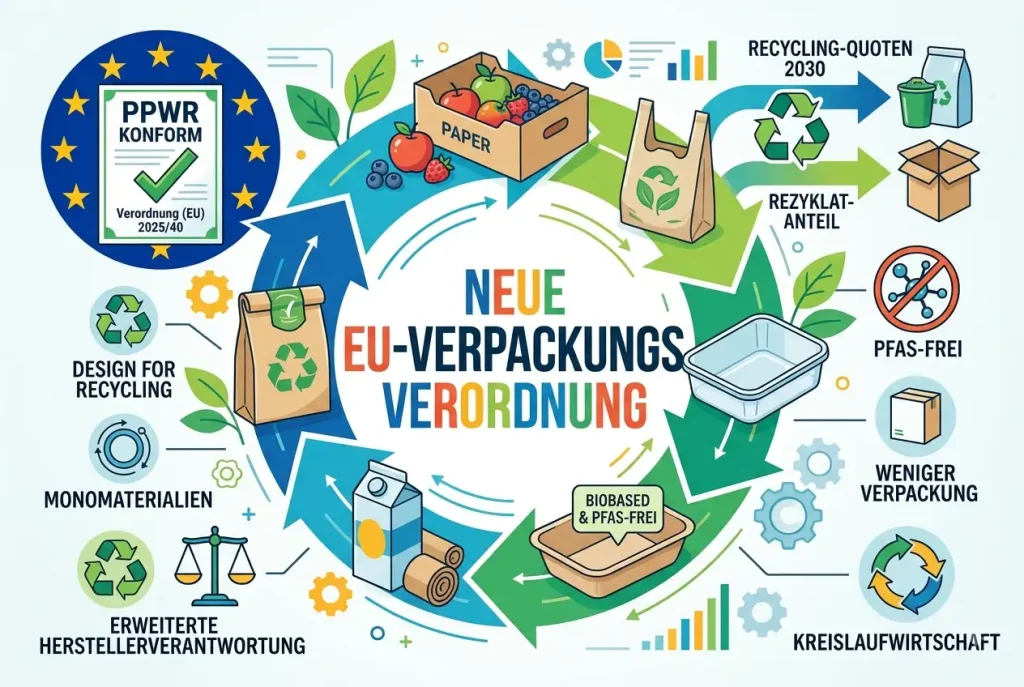
Key facts about the PPWR
- Deadline 12 August 2026: Directly applicable EU law (Regulation (EU) 2025/40) without national transitional legislation.
- Ban on PFAS: Grease- and water-repellent „forever chemicals“ are banned for direct food contact.
- Duty of proof: Manufacturers and bottlers must provide written proof that packaging is PFAS-free and be registered.
- Design for Recycling: Packaging must be purposefully designed for circularity and minimal empty space in future.
- Schedule up to 2040: Binding recycled material quotas and unified disposal labels will follow by the end of the decade.
Strict PFAS limits for food contact
Per- and polyfluoroalkyl substances (PFAS) were for years the standard for sealing cardboard, paper packaging and moulded fibre products against grease and moisture. As these substances do not break down in either the environment or the human body, the EU is now drawing a clear line.
- Limits in food contact: materials that are in direct contact with food must not under any circumstances exceed the strictly defined PFAS threshold values.
- Documentation requirement for fillers: Anyone who packages food or puts it into circulation must obtain written confirmation from paper manufacturers and converters that no PFAS additives have been used.
- Market shift: Industry is rapidly switching to plant-based coatings, specialist water-based paints and synthetic-free barriers.
Uniform EU law instead of national solo efforts
The transition from an old directive to a directly applicable EU packaging regulation puts an end to the previous fragmentation in the European single market. For companies operating across borders, this simplifies some requirements while simultaneously tightening controls.
- Extended Producer Responsibility (EPR): Whoever distributes own-brand products, imports goods or packages items is financially and organisationally liable for the entire lifecycle of the packaging.
- Mandatory registration: Placing goods on the market requires complete reporting in the respective national packaging registers – in Germany, this involves reconciliation with the Central Agency Packaging Register (ZSVR).
Design for Recycling: conserving materials and ensuring separability
Alongside the ban on harmful substances, the PPWR aims massively at reducing packaging waste. This has direct consequences for the packaging development of fresh and dry goods.
- Monomaterials are becoming established: composites that are difficult to separate in the recycling process are gradually being phased out. The trend is clearly moving towards single-material paper or plastic solutions.
- Ban on slack-fill packaging: unnecessary voids, double wrappings, and purely decorative packaging without a protective function are to be phased out.
The schedule for the coming years
The launch in August 2026 is only the first step. The transformation is structured in phases:
- 2026: Taking effect of the first PPWR obligations including PFAS restrictions and verification proofs.
- 2028: Obligation for standardised EU pictograms and QR codes on packaging to make waste sorting easier for consumers.
- 2030: Binding minimum quotas for the use of recyclates in plastics as well as initial bans on certain single-use formats (such as for unprocessed fruit and vegetables).
- 2035–2040: Proof of genuine recyclability at an industrial scale (Recycled at Scale) with the aim of reducing per capita packaging waste by 15 per cent.
Need for action in practice
For companies in the food chain, it is now primarily about securing their own supply chain. The following three steps are right at the top of the agenda:
- Request supplier certificates: request confirmations of PFAS-free status for all cardboard packaging, paper and film.
- Review packaging design: initiate the transition from composite materials to mono-materials and reduce empty space.
- Reconcile master data: Update your own registrations and volume reports with the competent authorities and systems.
Conclusion on the EU Packaging Regulation
The new EU Packaging Regulation challenges the food and packaging industry, whilst at the same time setting clear standards for sustainable innovation. Anyone who now checks supply chains for PFAS-free status, prioritises mono-materials and brings their registrations up to date is not only ensuring their own regulatory compliance, but also future-proofing themselves for the European single market.