


Sustainable and practical: How students teach robots to learn
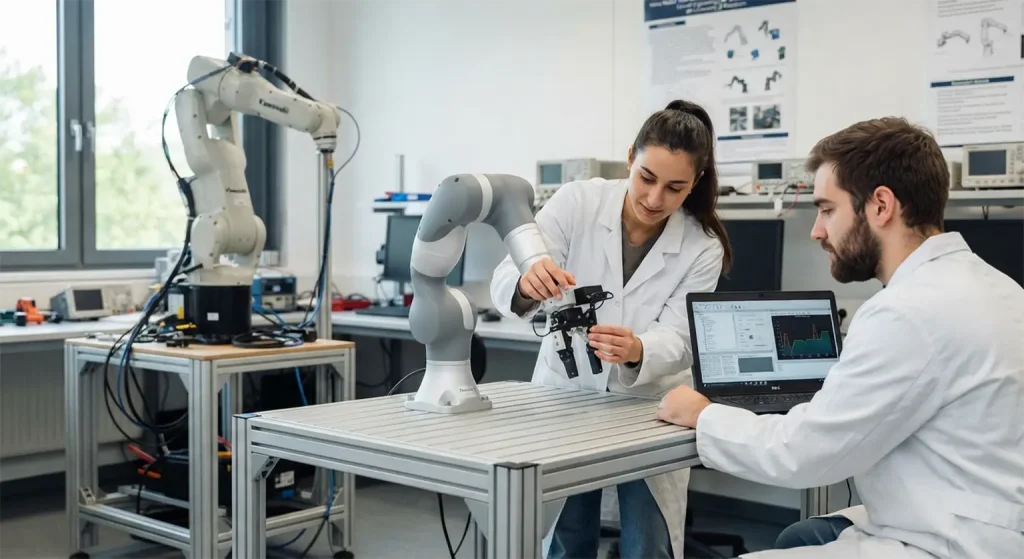
In the „KARL“ project at the University of Paderborn, students and research teams are taking matters into their own hands: they have restored two decommissioned industrial robots at the Heinz Nixdorf Institute. The machines are now serving as experimental subjects, where students can directly test modern artificial intelligence and learnable control systems in practice.
Key Facts at a Glance
- Project KARL: The acronym stands for „Knock-arm robot in the classroom“ and combines sustainable woodworking with modern AI training.
- Modernized hardware: A 6-axis robot from Kawasaki and a 7-axis model (Franka Emika Panda) were overhauled in the laboratory, rewired and made ready for use.
- Focus on AI training: „Reinforcement Learning“ is used – a learning method in which robots learn step by step through rewards, independently avoiding obstacles.
- Practical scenarios: The robots already demonstrate their skill when balancing a ball and picking up components from rotating trays.
- Right in the lecture hall: Thanks to illustrative explanatory videos and pre-built software setups, students can get started on the Chair of Control Technology and Mechatronics (RtM) without lengthy training.
As the report from the university shows, the scientific staff and student assistants have completely overhauled the unused machines in the Chair of Control Engineering and Mechatronics and equipped them with fresh sensors. Instead of purchasing expensive new equipment, the university is therefore relying on reuse – which saves resources and at the same time brings modern technology into the study routine without any barriers.
Practically-oriented testing of Reinforcement Learning
According to project employee Niklas Fittkau, the team’s main goal was to connect theoretical software models with real hardware. According to the participants, the so-called „reinforcement learning“ approach plays a central role in this process. In this approach, the control system learns – similar to a human – through trial and error. The system receives feedback via sensors: if a movement is successful without colliding, there are essentially bonus points. In this way, the robot develops the best route by itself step by step.
Repair and concrete examples of application
For the testing runs, the two different robot types were brought back to working order in the laboratory. According to the press release, the team developed a custom programming interface for the Kawasaki robot to enable flexible operation of the machine from a variety of software programs. With the Panda robot, the students demonstrated in their own final projects what is possible: the machine independently balances a ball and picks up components from two rotating trays to place them precisely in a new location.
Sustainable added value for academic training
The press release ensures that theoretical material from the lectures can finally be applied in practice. The team has created instructional materials and built complete test environments that are now firmly integrated into the exercises. Fittkau emphasizes that the students have been involved in the entire development process from the very beginning, right up to the final program. This strengthens collaboration between the various departments and prepares the future engineers for their professional careers in a practical way.