



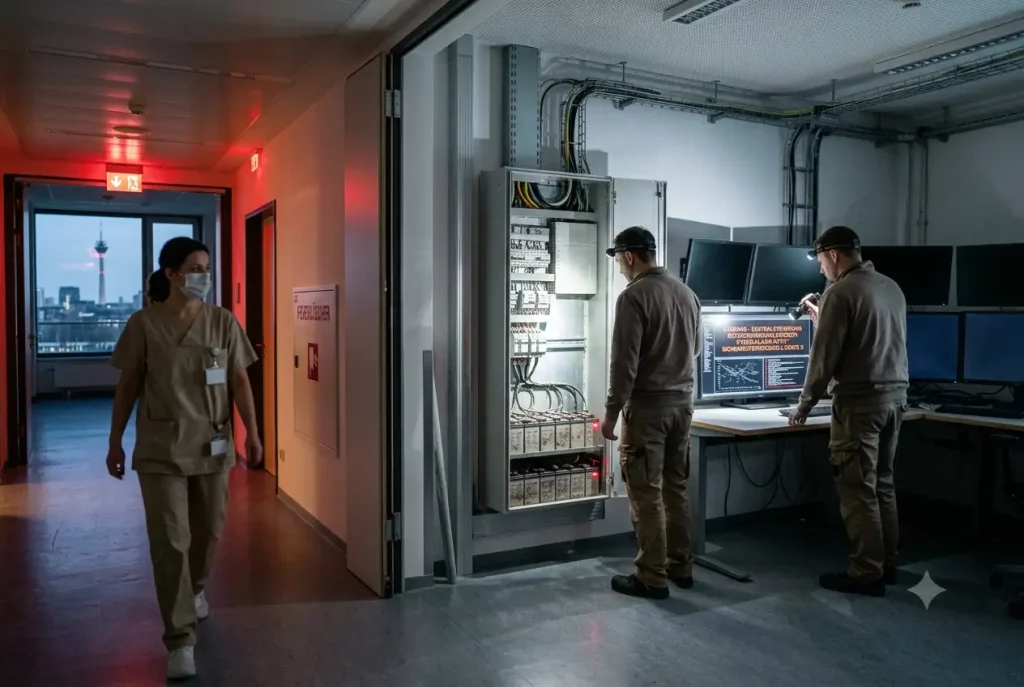
Germany's critical networks are coming under increasing pressure: while attacks on energy and transport networks are rising, significant vulnerabilities are becoming apparent in local emergency care. In every third special building such as hospitals or schools, emergency power systems do not function reliably in an emergency. The TÜV Association is therefore calling for targeted investment from the federal government and operators to fundamentally strengthen resilience against failure.
The key points:
- Real danger of sabotage: Targeted attacks on electricity, transport and communication are now part of the operational risk in Germany.
- Deficiencies in the backup power supply: 35 percent of emergency power systems in special structures show significant deficits – a trend that has been rising since 2022.
- Coupled systems: 15 per cent of companies report cyber attacks. Due to the close networking of digital control systems with physical plant technology, the potential for damage is growing.
- Investment requirement: TÜV advocates using funds from the federal special fund and placing greater obligations on private owners.
TÜV demands a change of course in the protection of critical infrastructure
Whether power supply, traffic IT or mobile communications: sabotage attempts and targeted disruptions are long since no longer a theoretical threat. The TÜV Association warns that these incidents are becoming a permanent stress test. Joachim Bühler, managing director of the association, sees an urgent need for action: mere early detection is no longer sufficient. Rather, resilience is decisive – critical systems must continue to run in an emergency or be able to restart without long delays following a failure.
Every third emergency power system in hospitals and schools is defective
How vulnerable many facilities are in everyday life is demonstrated by the current „TÜV Construction Law Report 2026“. In sensitive buildings such as hospitals, schools and shopping centres of all places, inspectors found significant defects in 35 percent of emergency power systems – a clear increase compared to 2022. The causes are mostly avoidable, yet have serious consequences: discharged starter batteries, expired fuel or generators that simply fail to start. To counteract this, the association proposes allocating federal funds from the special assets specifically for modern emergency power concepts. At the same浦 time, private operators would need to invest noticeably more of their own capital in maintenance.
Connected technology: When IT failures paralyse real systems
Alongside physical defects, the digital threat situation is worsening. According to the latest TÜV Cybersecurity Study, almost one in six companies (15 per cent) was the target of cyberattacks last year, often instigated by professional, sometimes state-sponsored groups. According to Bühler, the real risk lies in the interplay between both areas: if digital systems control physical components of building or transport technology, an IT collapse leads directly to the standstill of the entire facility. IT security and physical asset protection can therefore no longer be organised separately from one another in future.