


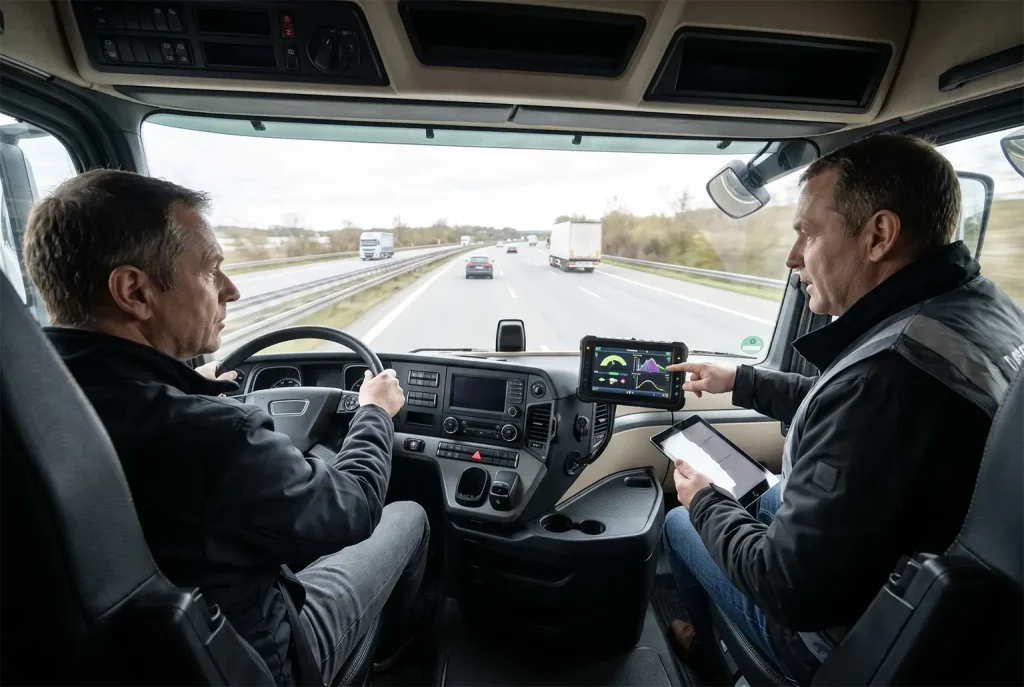
High fuel prices are putting transport and bus companies under sustained pressure. A practical training session conducted by SBS Fleet-Competence shows that diesel consumption can be reduced by up to 15 percent – without delaying tours. Using digital measurement technology directly in the familiar truck or bus, the training company demonstrates that anticipatory driving does not require time, but does reduce operating costs […]
- Up to 15 % savings: Significantly lower fuel consumption thanks to proactive driving.
- Quick amortization: According to the company’s statements, the training usually takes place within a few weeks.
- Fact-check Driving time: Precise measurement data show that economical driving does not reduce the average speed.
- Training in a real work environment: The trips take place directly in the usual vehicle – including a direct before-and-after comparison.
- Reduced wear: A quieter driving style saves on brakes and tires, reducing downtime and repair costs.
Rising fuel prices are weighing on margins
For many freight forwarders and bus operators, fuel costs are the largest expense item after personnel costs. Even minimal deviations add up over the course of the year: If a truck needs only one liter more per 100 kilometers, that quickly adds up to around 20,000 euros in additional costs for a fleet of ten vehicles. According to the experience of SBS Fleet-Competence, this potential for savings is often wasted in everyday life, because on the steering wheel, there is simply a lack of routine for driving in a consumption-optimized manner.
Telematics dispels prejudices: Efficiency is not reduced
This is where the concept comes into play: Instead of dry theory, the drivers train directly in their familiar work vehicles. In contrast to the widespread prejudice that „those who save fuel lose time,“ the trainers present hard facts. Precise measurement technology captures parameters such as engine speed, gear selection and acceleration behavior during driving. The evaluations reliably show that those who anticipate the situation, shift up early and let the vehicle roll, significantly reduce fuel consumption – but they also reach their destination just as quickly.
Reduced wear and tear, lasting effect
For fleet operators, the investment usually pays off within a few weeks. In addition, there is a tangible side effect: predictive driving saves brakes and tires and reduces unplanned visits to the workshop. Managing Director Olaf Horwarth emphasizes that behavioral changes only work through practice: Drivers only permanently internalize a frugal driving style when they have experienced the difference themselves behind the wheel. For long-term success, SBS also recommends that management teams specifically recognize measurable progress within the team.