


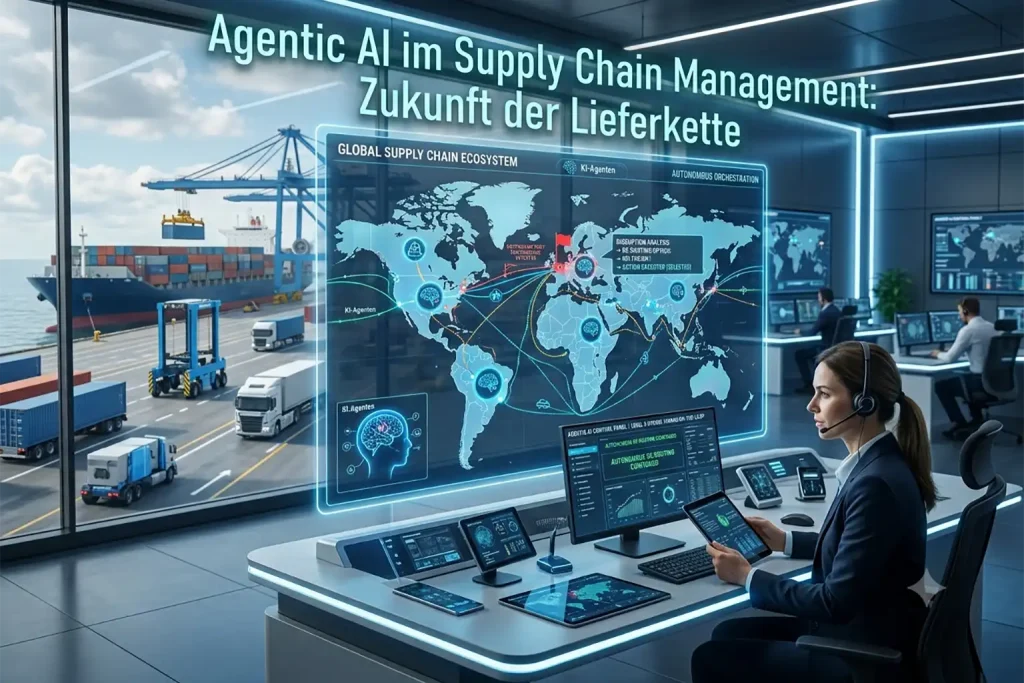
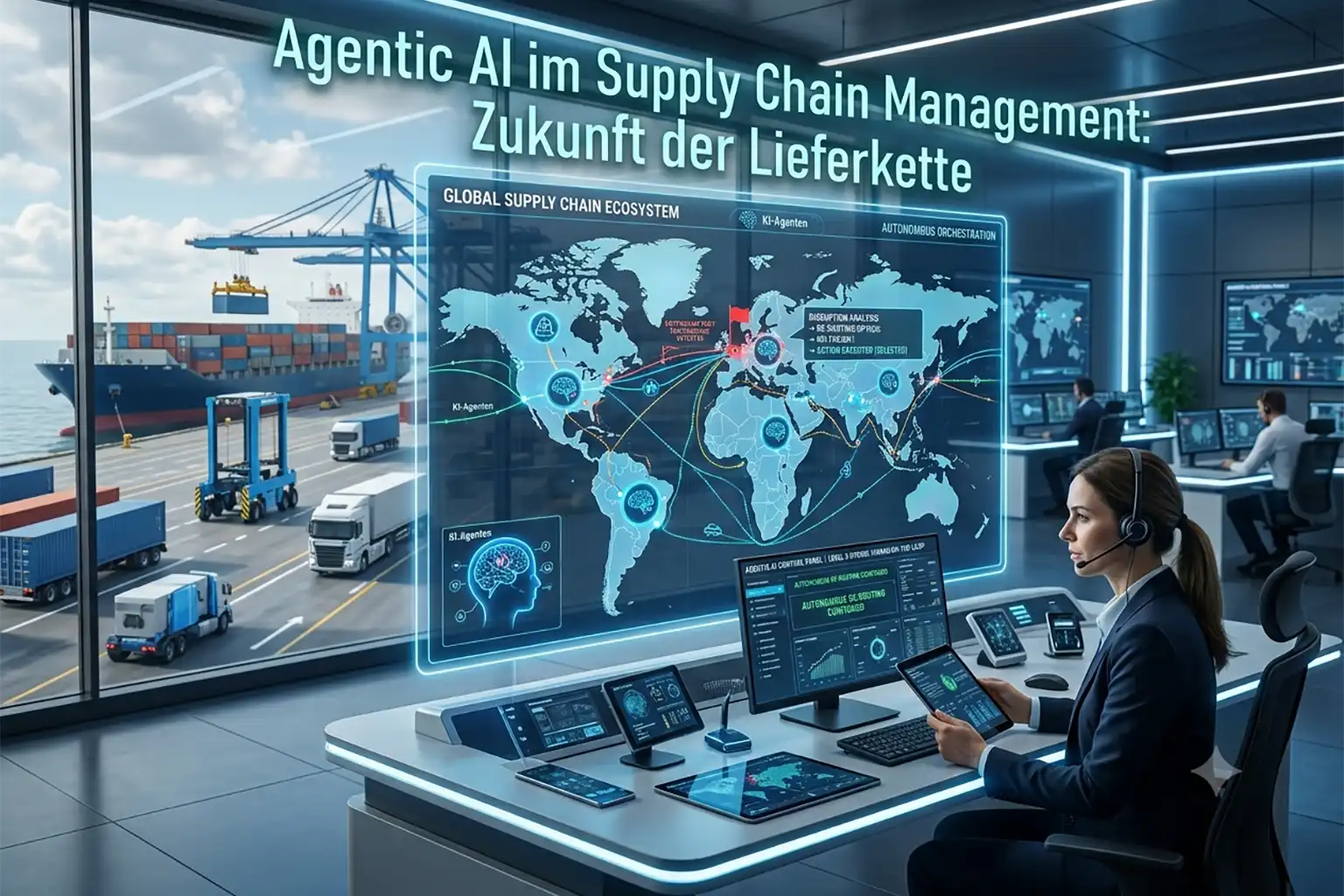
The use of Agentive AI in Supply Chain Management heralds the transition from reactive and purely predictive supply chains to autonomously acting ecosystems. Unlike conventional or purely generative AI, they analyse AI agents data, but also make goal-oriented decisions independently and execute actions in ERP and SCM systems. The most successful implementation pattern is the hybrid model (human-in-the-loop): AI agents take over complex operational routine tasks and disruptions within the defined framework, while Logistics experts maintain strategic control and governance.
Agentic AI in Supply Chain Management – Key Facts at a Glance
- Definition: Agentic AI describes autonomous AI systems that independently break down complex goals, plan action paths, utilise external tools (APIs, ERPs), and perform actions without manual intervention.
- Core difference from GenAI: Generative AI creates text or code based on prompts; Agentic AI acts with a specific goal within a system environment (e.g., independent reordering, rerouting of freight).
- The hybrid model: Human decision-makers set the guardrails (governance) and only intervene in defined exceptions (management by exception).
- Core benefits: Reduction of supply chain disruption response times from days to seconds, significant inventory optimisation and drastic reduction of operational logistics costs.
- Areas of application: Autonomous disruption management, real-time route reswcheduling, automated supplier communication, and dynamic inventory management.
1. What is Agentic AI and how does it differ from classical AI?
- Predictive AI (past to present): Generates forecasts (e.g. „Demand for product X will rise by 15 % next week“). Implementation has always required human intervention.
- Generative AI (Present): Creates reports, summarises documents, or answers queries in natural language.
- Agentic AI (The Future): Understands the overarching goal (e.g., „Secure raw material supply for product Y within budget Z despite port strike“), plans sub-steps, negotiates with suppliers via APIs, books alternative freight capacity, and autonomously updates the ERP system.
Agentic AI connects large language models (LLMs) with logical reasoning and functional interfaces. It does not wait for human prompts for every step, but works in a goal-oriented and adaptive manner.
2. The hybrid model: The symbiosis of AI autonomy and human control
The operational deployment of fully autonomous systems carries risks, particularly in the case of unexpected extreme events (black swan events). Consequently, the hybrid model (human-in-the-loop / human-on-the-loop) is gaining traction in practice.
The autonomy levels in the hybrid model
- Level 1 (Assisted): AI makes suggestions; the human performs all actions manually.
- Level 2 (Semi-autonomous): AI performs routine tasks after human approval.
- Level 3 (Conditionally Autonomous / Hybrid Standard): AI acts autonomously within predefined parameters (e.g., triggering orders up to a value of €50,000). If limits are exceeded or the situation is unclear, it is escalated to experts.
- Level 4 (Highly Autonomous): AI controls complete processes independently and merely notifies the human via dashboard.
„The greatest strength of modern technology lies not in replacing humans, but in giving them crucial seconds of reaction time in complex moments.“
Expert tip: The hybrid model protects against loss of control while simultaneously utilising the speed of autonomous software agents. Supply chain managers are transforming from operational dispatchers to strategic system orchestrators.
3. Concrete Use Cases of Agentic AI in the Supply Chain
A. Autonomous Disruption & Risk Management
If a disruption occurs (e.g., low water levels on the Rhine or the blockage of a sea canal), Agentic AI does not wait for the next shift meeting. The agent:
- Captures weather, geographic data and news feed messages in real-time.
- Identifies affected containers and production plans.
- Compares alternative transport routes (rail vs. air freight) with regard to costs and emissions.
- Books the freight independently by rulebook on a capacity basis.
B. Dynamic Supplier & Inventory Optimisation
Agents monitor stock levels in real time and incorporate external influencing factors such as raw material price fluctuations, holidays, or regional peaks in demand. If a stock level reaches critical thresholds, the AI agent not only triggers a standard order but also queries multiple suppliers for availability, compares conditions, and completes the order.
C. ESG and Supply Chain Due Diligence Compliance
Agentic AI continuously checks supplier data, certificates, and third-party sources for breaches of environmental or labour law standards. If the agent detects risks with a subcontractor, it automatically initiates audit processes or suggests alternative, certified partners.
Would you like a brief consultation on this?


4. Deep Dive: Step-by-Step Anatomy of an Autonomous AI Decision
To understand how agentic AI works in practice, let's consider the technical and logical sequence of a real-world fault scenario via the so-called ReAct loop (Reasoning + Acting):
Step 1: Perception & Triggers
An external event stream (e.g. an IoT GPS tracker or an API feed from a logistics provider) reports an unplanned delay of a cargo ship by 72 hours.
Step 2: Impact Analysis & Reasoning
The primary disruption agent analyses the effects in conjunction with the ERP system:
- Which production orders are affected? (Result: Plant B faces a line stoppage in 48 hours).
- Welche monetären und operationalen Konsequenzen entstehen? (Ergebnis: Pönale von 20.000 € pro Tag).
Step 3: Multi-Agent Orchestration (Planning)
The main agent delegates sub-tasks to specialised sub-agents.
- File Agent: Checks security stock levels in surrounding backup warehouses.
- Sourcing Agent: Enquires with two alternative suppliers for express air freight quotas.
- Finance Agent: Calculates the total cost of the hedging options compared to the looming band shutdown.
Step 4: Autonomous Execution (Action)
The sourcing agent identifies suitable air freight capacity for €12,000. As this amount is below the predefined autonomy limit of €20,000, the agent directly executes the order via REST API, creates the rerouting documents in the TMS, and updates the production plan in the SAP system.
Step 5: Logging & Reporting (Governance)
The entire process, including all selected alternatives, cost-benefit matrices, and API response logs, will be stored securely and immutably in the audit trail. The responsible Supply Chain Manager will receive a summarised push notification on their dashboard.
5. Practical Example: How an Industrial Company Uses Agentic AI in Everyday Operations
To break down the abstraction, the following scenario from a medium-sized mechanical engineering company illustrates the practical benefits:
Starting position & problem statement
A special machine manufacturer procures critical control components from a main supplier in East Asia. Due to an unforeseen typhoon event, a primary export terminal will be closed for at least six days.
In traditional practice, it typically took 24 to 48 hours for the message to reach the dispatcher, be manually reconciled in the ERP, quotes for replacement components obtained, and approved by the purchasing manager. The frequent consequence: expensive express surcharges or production downtime.
The process with Agentic AI (Hybrid Model)
- Early warning at 02:15 AM: The sensor agent detects the port closure via geofencing data and weather feeds.
- System check at 02:16: The stock agent is reconciling the bills of materials (BOMs). Result: The buffer at the plant is sufficient for another 3 days. A delivery delay is looming for three key customers.
- Autonomous quote negotiation at 02:18: A sourcing agent automatically contacts two European alternative suppliers via API and requests up-to-date quotas and prices.
- Threshold check & decision at 02:20:
- Option A (Air freight from Asia via alternative port): Cost €18,500, delivery time 48 hours.
- Option B (European Secondary Supplier): Cost £24,000, delivery time 24 hours.
- Autonomous Execution & Human-in-the-Loop: As the predefined emergency budget for imminent belt stoppages of up to €30,000 has been released, the agent opts for Option B, triggers the order in the SAP system and secures the express special journey.
The result
When the responsible Supply Chain Manager begins his workday at 07:30, the problem is already solved. He finds no emergency on his dashboard, but a completed audit log of the measure already implemented. Production continues without interruption.
6. Step-by-step phase model for implementation
The introduction of agentic AI does not require an abrupt overhaul of the entire IT landscape. A gradual, risk-minimised approach guarantees control at all times:
Phase 1: Data and API Readiness Check
Building the technical foundations. External data sources, IoT feeds, and internal ERP, WMS, and TMS systems are interconnected via clean REST APIs. The goal is to provide read and write permissions in a structured manner.
Phase 2: Sandbox Pilot and Shadow Mode
The agent runs passively in the background (Shadow Mode). It analyses real fault incidents and generates recommended actions, but does not yet execute them. Experts compare the AI's suggestions with the decisions of human dispatchers in order to calibrate the system.
Phase 3: Partial autonomy with tight guardrails
The agent receives active write access in the ERP but operates within strictly defined limits (e.g., order releases up to a maximum of €10,000, predefined supplier lists). Decisions outside of these parameters require manual confirmation in the dashboard (human-in-the-loop).
Phase 4: Scaling & Multi-Agent Orchestration
Following a successful test phase, the degree of autonomy will be gradually increased. Several specialised agents (purchasing, logistics, finance) will operate together as a network, independently resolving complex end-to-end processes.
7. Measurable ROI: The key KPIs for measuring success
To achieve economic success in Agentic AI Supply Chain Management The following key performance indicators serve as a benchmark to transparently demonstrate to management:
- MTTR (Mean Time to Resolution): Measures the duration from the identification of a supply chain disruption to the implementation of a countermeasure. Agentic AI typically reduces this time from several days to a few minutes.
- OTIF Rate (On-Time In-Full): Measures the proportion of orders that arrive at the customer on time and in full. Autonomous freight rerouting ensures high delivery reliability, even during global shocks.
- Special freight & ad-hoc costs: As agents detect disruptions much earlier, more cost-effective alternative routes can be booked before expensive emergency express transports become necessary.
- Process costs per order: Drastic reduction of manual data entry and reconciliation effort in the purchasing and planning departments.
8. Comparison: Traditional vs. Agentic Supply Chains
Traditional / Predictive Supply Chain
- Decision-making: Manual, based on static reports and dashboards.
- Response time: Hours to days for disruptions.
- System integration: Isolated data silos; ERP systems must be maintained manually.
- Scalability: Directly tied to personnel resources.
- Human role: Operations dispatcher and data processor.
Agentic AI Supply Chain (Hybrid Model)
- Decision-making: Autonomous, goal-oriented and rule-based.
- Response time: Seconds to minutes in real time.
- System Integration: Seamless orchestration via cross-system interfaces (APIs).
- Scalability: Exponential, as operational routine processes run autonomously.
- Role of humans: Strategic controller, approval authority and rule setter (governance).
9. Challenges, Data Quality, and E-E-A-T Compliance
For the use of Agentic AI to be trustworthy, safe, and sustainably successful, companies must address key challenges:
1. Data Readiness & System Architecture
Agents are only as good as the data they can access. A structured data lake, along with well-defined REST APIs to the ERP (e.g. SAP S/4HANA), WMS and TMS systems are imperative.
2. Risk of Hallucinations and Misjudgement
Agents require strict guardrails. These include:
- Financial Limits: Maximum Budgets per Autonomous Transaction.
- Error tolerances: Automatic verification of responses and plans before execution.
- Audit Trail (Traceability): Every decision and action of the AI agent must be logged comprehensively to comply with regulatory standards and E-E-A-T criteria (Transparency & Reliability).
3. Change Management
The introduction of AI agents is significantly changing job profiles in logistics. Employees need to be trained to monitor these agents, understand their logic, and competently manage exceptional situations.
10. Conclusion & Outlook on Agentic AI in Supply Chain Management
„In a connected global economy, it's not the supply chain with the most rigid plans that wins, but the one that can adapt most quickly to the unpredictable.“
Agentive AI in Supply Chain Management is not a short-term hype, but the logical evolution of the digital supply chain. While generative AI has transformed knowledge management, agentic AI is transforming operational execution.
Companies that adopt a functioning hybrid model early on secure crucial competitive advantages: they increase their resilience to global shocks, cut process costs, and free up their specialists from monotonous routine work. The future of supply chains belongs neither to pure autonomy nor to manual operation – it belongs to the intelligent orchestration of humans and AI.
11. Frequently Asked Questions (FAQ) about Agentic AI in Supply Chain Management
What is the main difference between automation (RPA) and agentic AI?
RPA (Robotic Process Automation) rigidly follows predefined rules (If-This-Then-That) and aborts as soon as unexpected deviations occur. Agentic AI, on the other hand, uses AI reasoning to independently develop alternative solutions and make adaptive decisions when faced with unforeseen problems.
Will Agentic AI replace humans in supply chain management?
No. The goal is not a supply chain devoid of humans, but the alleviation of routine decisions. In the hybrid model, AI handles the rapid processing of standard cases and minor disruptions. Humans remain indispensable for strategic negotiations, building relationships with key customers, and managing complex crises.
What IT requirements are necessary to get started?
Prerequisites include a modern cloud data architecture, clearly structured APIs for connecting ERP/WMS/TMS systems, and defined security and authorisation concepts (role-based access control) for the AI agents.
How is safety ensured in autonomous AI actions?
Through multi-stage thresholds and governance rules. Actions below certain risk thresholds are executed autonomously. As soon as parameters such as budget, safety quantities or quality standards are exceeded, the system requires explicit approval from the human operator (Human-in-the-Loop).