



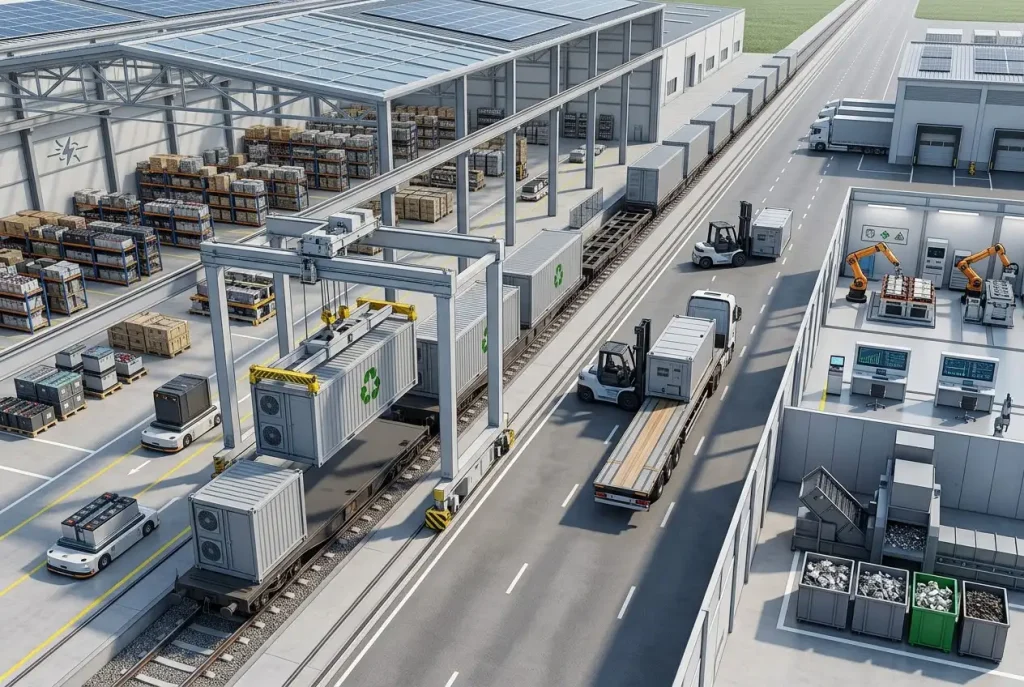
DHL Group is significantly expanding its global logistics for batteries and energy storage systems. To this end, the group is pooling the resources of its Supply Chain, Global Forwarding, and Express divisions. The aim is to cover the entire product life cycle from a single source – ranging from raw material logistics and worldwide transport through to take-back and recycling.
Key facts about the DHL logistics network
- Network expansion: expansion of the more than 20 existing specialist locations, including 13,000 m² of additional warehouse space in Halle and a new logistics centre in Hungary (scheduled commissioning 2027).
- Integrated services: close integration of production logistics, dangerous goods transport, customs clearance and technical services such as battery diagnostics, charging infrastructure and repairs.
- Response to market changes: alignment with altered trade routes between Asian manufacturing hubs and Western markets while simultaneously managing high technical complexity (battery systems with individual weights of in some cases over 50 tonnes).
- Focus on major projects: Strong growth in industrial battery energy storage systems (BESS) with more than 1,100 units delivered in the first half of 2026 alone.
- Growth target for 2030: The „New Energy“ segment is a key pillar of the 2030 corporate strategy, with the aim of achieving annual revenue of 3 billion euros.
Strategic network expansion and integrated service offering
To meet the rapidly rising demand from electromobility, cell manufacturing and the renewable energy sector, DHL is relying on an end-to-end logistics network. Across its three divisions—Supply Chain, Global Forwarding and Express—the existing infrastructure of more than 20 specialist sites is being continuously expanded.
The range of services goes beyond mere transport and storage: integrated aspects include production-related logistics, specialised battery diagnostics, repairs, and preparation for recycling. Specifically, the group is expanding its Halle site by 13,000 square metres of battery-compliant storage space, amongst other measures; furthermore, the commissioning of another site in Hungary is planned for 2027.
Response to changing trade flows and increasing complexity
Drivers of these investments are noticeable shifts in the global market. Whilst the focus of cell and module manufacturing remains in Asia, demand in Europe and North America is increasing continuously. In parallel, logistical and regulatory requirements are growing: industrial battery systems often weigh more than 50 tonnes and are subject to strict dangerous goods and customs regulations.
Against this backdrop, Francisco Milián from DHL Supply Chain EMEA underlines the need for reliable end-to-end solutions along the entire lifecycle. To ensure that even time-critical shipments are handled securely and in compliance with regulations, DHL is simultaneously expanding its capacities in the road and air freight network, as Christopher Ong from DHL Express Singapore highlights.
Major projects and economic growth targets up to 2030
The expansion is not limited to the automotive sector, but specifically encompasses large-scale battery energy storage systems (BESS) and infrastructure projects. Martyn Lawns from DHL Industrial Projects estimates the volume so far at over 1,100 transported BESS units in the first half of 2026 alone.
Hendrik Venter, Global CEO of DHL Supply Chain, emphasises the logistics provider's commitment to supporting customers comprehensively along emerging trade routes – from component manufacturing to closing material loops. Economically, the „new energy“ sector forms a core growth area of Strategy 2030: by the end of the decade, annual revenue in this segment is expected to rise to 3 billion euros.