


Keyfacts about AI in procurement in 2027
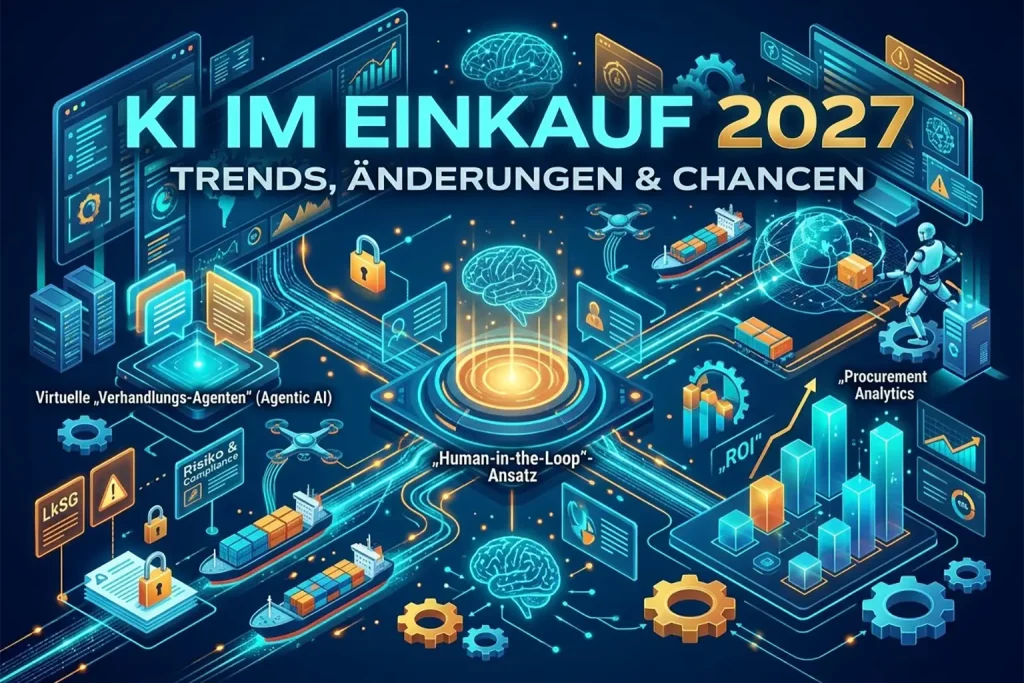
- Technological core: The transition from pure text assistants to action-capable software agents (Agentic AI) that interact directly with ERP and supplier systems.
- Hybrid approach: Up to 95% % of operational tail spend runs autonomously; strategic product groups, framework contracts, and supplier relationships remain firmly in human hands.
- Ongoing compliance: Permanent monitoring of legal requirements such as LkSG, CSRD and CBAM replaces time-consuming, point-by-point annual audits.
- Business benefits: 30 to 40 % fewer process costs, reduction of Maverick Buying by over 70%, % and amortization periods for modern procurement solutions of between 12 and 18 months.
- Critical factors: Insufficient quality of master data hampers project implementation; clear liability and governance rules in accordance with the EU AI Act are mandatory.
1. The hybrid model: The human-machine symbiosis in purchasing
„The best technology is of little use if in an emergency no one is available who understands the personal relationship with the supplier and can make situational assessments.“
In everyday life, this model means a clear, logical division of labor:
- Task distribution based on complexity: Algorithms handle standardized C-parts, catalog orders, and recurring needs. Human procurement teams manage strategic key product groups, negotiate bottleneck items, and specifically develop suppliers.
- Negotiation logic: Software operates on a schedule within predefined budgets and conditions. Humans negotiate where trust, soft factors, long-term partnerships, or ESG agreements are the deciding factors.
- Processing market data: Systems scan millions of data records, price indices and global reports for anomalies. The purchasing team assesses the validity of these signals and what strategic conclusions management must draw.
- Risk and compliance management: The AI scans sanctions lists, media reports, and LkSG-relevant incidents 24/7. In the event of specific suspicious cases or supply bottlenecks, experienced buyers initiate targeted corrective measures.
- Authorizations and responsibility: Autonomous agents have clear limits on their competence for routine operations. Any decision regarding direction, any strategic selection of suppliers, and any long-term contract require human authorization.
The goal is not to save on skilled labor, but to free up time from administrative chores. Those who no longer spend their time following up on order confirmations have again available resources for strategic value creation.
2. The 5 dominant AI trends in procurement by 2027
1. Agentic AI & Autonomous Negotiation Agents
The phase in which buyers typed prompts into chat windows is over. The move towards agentic AI marks a new stage of maturity. Autonomous software agents receive specific orders: they independently contact suppliers, request offers, match parameters, and conduct multi-stage conditional negotiations within pre-defined bandwidths. When the goal is achieved, the finalization process is complete.
2. Zero-Click Spend Analytics & Expense Reconciliation
In the past, spend transparency meant weeks of exporting, cleaning, and merging Excel tables. By 2027, Zero-Click Intelligence will be established: systems automatically assign product groups based on eCl@ss or UNSPSC in the background, clean up booking texts, and immediately alert on internal price discrepancies or unauthorized Maverick Buying.
3. Continuous real-time risk & ESG monitoring
Static supplier questionnaires no longer meet the requirements of LkSG, CSRD and CBAM. Modern monitoring systems continuously evaluate global sources: from local news sources to insolvency databases to traffic and weather data. If a problem arises, the system alerts you long before a production stoppage occurs.
4. Predictive Should-Cost Modeling
To conduct price negotiations on equal terms, buyers resort to predictive costing models. These calculate component prices („Should-Costs“) on a daily basis based on real raw material prices, regional energy costs, tariff structures, and freight rates. Negotiation leaders therefore often know more precisely than the supplier itself what a product’s actual manufacturing costs may be.
5. Generative Contract Lifecycle Management (CLM)
Manually reviewing hundreds of pages of delivery contracts is a thing of the past. Intelligent contract checkers scan drafts against internal legal standards, identify unfavorable liability clauses or unilateral price adjustment clauses, formulate change proposals, and automatically monitor termination deadlines.
3. Structural changes: role models, processes, and system architecture
The deployment of autonomous systems profoundly impacts organizations and processes. Three levels are fundamentally changing:
From Buyer to „Procurement Agent Orchestrator“
Classic administrative tasks are gradually losing importance; more demanding profile tasks are taking their place:
- Procurement Data & AI Orchestrator: Defines corridors, permission limits, and quality rules within which autonomous systems may operate.
- Value Chain Architect: Analyzes global value chains, diversifies sources of supply, and builds close partnerships with technology partners.
- Category Strategist: Uses automated market analyses to formulate and implement well-informed product group strategies across the company.
Changes in the distribution of time and tasks:
- Previous distribution of time: About 70 % % was spent on operational routine and data entry, 20% % on tactical inquiries, and only 10% % on strategic planning.
- Time allocation in 2027: Only about 10 % remain for manual exception permissions, 30 % for the control and monitoring of the systems, and 60 % for real value creation, supplier negotiations, and future planning.
Event-driven instead of rigid processes
Until now, procurement has followed a rigid process: requirement, tender, negotiation, order, and delivery of goods. In the future, the organization will respond in a more event-driven manner. For example, if the system detects delays at a traffic junction, the software will calculate alternative sources of supply, examine contractual buffer stocks, and prepare options before a production bottleneck becomes noticeable.
Modern interface architectures
Heavy-duty monoliths are complemented by flexible interface architectures. Through standardized protocols and APIs, intelligent applications access ERP systems, logistics databases, and procurement platforms directly. Data no longer remains locked in isolated silos.
Would you like a brief consultation on this?


4. Opportunities and measurable business potential
Companies that take the step towards technology-based hybrid purchasing secure themselves measurable competitive advantages:
- Significant reduction in processing costs: The automated processing of order requests, invoice reconciliation and schedule monitoring reduces the pure processing costs per order by 50 to 80 %.
- Genuine leverage of the tail spend: Due to a lack of time, edge suppliers have rarely been renegotiated in the past. Autonomous negotiation tools achieve reliable discounts of 4 to 7 % in this segment without overloading their own teams.
- Shorter response and procurement times: What used to take weeks – from supplier research to comparable offers – can be shortened to a few days or even hours.
5. Deep Dive: Autonomous Negotiation Management and Multi-Agent Architecture in Practice
Behind the term „Negotiation AI“ lies 2027 not a simple text program, but a combination of specialized systems that operate in separate units:
- Specialized task division: A sourcing agent researches suitable suppliers and verifies formal certificates. In parallel, a risk agent checks the creditworthiness and supplier ratings. Only when both give the green light does the negotiation agent contact the supplier side.
- Multidimensional negotiation management: Professional systems do not just negotiate the cents. They balance parameters: a minimally higher unit price is acceptable if the supplier extends payment terms by 30 days in return, operates a buffer stock at their own expense, or guarantees fixed CO2 targets.
- Interfacing communication: Shopping agents are increasingly encountering digital counterparts on the sales side. Negotiations regarding routine conditions are structured in such cases through defined protocols until an agreement is reached within the respective guidelines of both parties.
- Built-in safety nets: If a partner requires advance payment, deviates from the terms and conditions of the agreement, or exceeds the predetermined budget, the system immediately breaks the automatic process. The summary of the issues is then placed on the desk of the responsible buyer.
6. Practical Example: Autonomous Tail-Spend Negotiation in the Industrial Mid-Market
The example of a mechanical engineering company with 500 employees and a purchasing volume of around 75 million euros illustrates how this approach works in practice:
- The situation was as follows: the six-person team was stuck in day-to-day operations. Over 3,000 annual orders for tools, consumables and occupational safety equipment were tying up valuable time. Over 70 % of the supplier contracts in this area had not been reviewed for more than three years.
- The approach: The company hired a negotiation agent for indirect needs. The purchasing team set clear guidelines: target savings range between 5 and 8 %%, payment target 45 days, strict compliance with the code of conduct.
- The implementation: The software analyzed past purchase prices, compared them with current benchmarks, and contacted 160 suppliers digitally. The system independently handled standard cases in two to three automated loops. As soon as suppliers raised objections, the process moved to a short approval process for the human resources involved.
- The result after six months:
- In the targeted product groups, procurement costs decreased by an average of 5.2 %%, which represented a savings of around 230,000 euros.
- The workload for standard orders was reduced by more than two-thirds.
- The team used the time gained to reconfigure two strategically critical supply chains in a crisis-proof manner through nearshoring.
7. Challenges: Data quality, the EU AI Act, and risk management
Despite the benefits, the step towards automation is not a straightforward process. Companies must overcome specific obstacles:
„Whoever feeds dirty master data with artificial intelligence is simply creating faster waste.“
1. Master data as Achilles heel
Every system depends on data quality. Double-checked suppliers, outdated payment terms, or inconsistent item descriptions inevitably lead to incorrect decisions. Anyone who does not have their master data under control fails to implement autonomous assistants. Sound data governance is a must before the crunch comes.
2. Regulatory requirements and the EU AI Act
Systems used for the automated evaluation or classification of business partners are subject to regulatory requirements. The European legal framework requires transparent decision criteria and accountability. Automated supplier exclusions must be substantiated and documented to eliminate legal risks.
3. Data protection and safeguarding of one's own know-how
When systems review offers, read contracts, and negotiate prices, they are dealing with highly sensitive operational data. The use of public standard tools is self-evident. Protected corporate environments, clear access restrictions, and transparent interfaces are necessary to prevent confidential pricing information from leaking out.
8. Roadmap 2027: In 5 phases towards AI-powered shopping
For implementation, a step-by-step approach is recommended that yields quick results without overstraining the team:
- Phase 1: Establishing the basics (Months 1–2)
- Auditing master data, cleaning up duplicates, and defining clear product groups.
- Mandate internal game rules and value limits for automated processes.
- Phase 2: Initial workload relief (Months 3–5)
- Introduce tools for automated text analysis in tenders and contracts.
- Automate expense analyses to make Maverick Buying visible.
- Phase 3: Integration of the core systems (Months 6–8)
- Connecting the special tools to ERP and procurement platforms via interfaces.
- Activate continuous risk and compliance monitoring for existing suppliers.
- Phase 4: Automation in routine purchasing (Months 9–12)
- Negotiation agents control the C-part area and start when there is a need for additional resources.
- Establish and fine-tune release processes for exceptional cases within the team.
- Phase 5: Further development and consolidation (from month 12 onwards)
- Compulsory investment of earned working time in product group strategies and partnerships.
- Deepen training so that buyers can fully fulfill their role as sovereign taxpayers of technology.
9. Conclusion: AI in Procurement 2027 – The autonomous creator of value
AI in Procurement of the Year 2027 It is neither a pure data center nor a pure paper filing system. The strength of successful departments lies in deploying technology where it is superior to humans: in speed, data volume, and pattern recognition. At the same time, humans remain indispensable where skill in negotiation, judgment, and personal relationships determine business success. Those who do their homework with the master data and involve their team early create a purchasing process that is no longer perceived as a cost factor but as a strategic competitive advantage.
10. FAQ: Frequently asked questions about AI in procurement in 2027
Who is liable if an autonomous negotiation agent makes a wrong decision?
Legally, the purchasing company is always responsible. If a system concludes a contract within the scope of its granted authorization, this is legally valid. Therefore, strict value limits, standardized framework conditions, and emergency stops are essential.
Does artificial intelligence make experienced buyers redundant?
No, on the contrary. Routine tasks are eliminated, but strategic decisions gain in importance. Negotiations in difficult market conditions, collaborative problem-solving, and managing unpredictable crises require human intuition and experience that no algorithm can replicate.
At what purchase volume does the use of modern procurement tools pay off?
Even in the high-end midmarket with a purchase volume of around 15 to 20 million euros or for many small orders, specialized software solutions often pay off within the first year. The leverage lies primarily in leveraging unused savings in the tail spend.
How does technology help with compliance with the Supply Chain Act (LkSG)?
Systems continuously monitor international news, government registries, and industry reports in a wide variety of languages. If there are signs of labor or environmental violations at a supplier, the buyer receives an immediate alert, including a recommended course of action, rather than having to wait until the next annual report.
What requirements must be met for the internal data?
A clean foundation is indispensable: supplier records must be cleansed, items must be clearly identified, and order histories must be available digitally. Modern systems can process unstructured documents, but the more consistently the master data is maintained, the more precise the underlying models will operate.